Free coaching tool
Serve-receive rating in volleyball: A-D and 0-3 passing average calculator
From the Vollyze product team. This calculator follows a common 0-3 passing scale and explains how it differs from the A-D receive grades shown in Vollyze.
A volleyball passing average turns a set of serve-receive grades into one number. The calculation is useful because it summarizes whether first contact regularly kept the offense available. It is also easy to misuse. A 2.10 average does not explain the serve difficulty, the receiving formation, the rotation or what the team did with the next contact.
Use the calculator below for the arithmetic, then keep the sample size and rally context beside the result. The goal is not to give a passer a permanent label. It is to identify the reception situation the team should stabilize next.
0-3 scale
Passing average calculator
Enter the number of serve receptions graded 3, 2, 1 and 0. Results update as you type.
- Total receptions
- 0
- 3-pass share
- --
- Reception error share
- --
Add at least one reception or load the example.
Formula (3-passes x 3 + 2-passes x 2 + 1-passes x 1) / total receptions
The short answer
The average is only as consistent as the rating guide.
Agree on what keeps the setter and attackers available before comparing players, matches or months. Then review the number with the serve pressure and the rally result.
- Rate Use one shared definition.
- Calculate Keep the denominator visible.
- Coach Train the context behind the change.
What does the 0-3 passing scale mean?
For many high school and club programs, a 0-3 scale grades how many realistic offensive options remain after serve reception. Hudl describes a common version as 3 for a perfect pass, 2 for a good pass, 1 for a poor pass or overpass and 0 for a reception error. Other staffs change the target area or the number of available attackers, so the labels are not a universal rule.
Reference: Hudl's explanation of pass quality ratings. Use your staff's documented definitions when they differ.
How is volleyball passing average calculated?
Multiply each reception count by its rating, add the points and divide by the total receptions. A group with 12 three-passes, 8 two-passes, 4 one-passes and 2 errors has 56 rating points across 26 receptions. Its passing average is 2.15.
Do not drop the zero-passes from the denominator. They are still reception attempts and have a large effect on the average. Keep the total beside the result: 2.15 from 26 receptions is more useful than 2.15 with no sample size.
How A-D serve-receive grades compare with 0-3
An A-D system can describe the same quality order in language that is quick to read on a phone: A is the strongest reception and D is the weakest. It is reasonable for one staff to define A=3, B=2, C=1 and D=0, but that conversion is valid only when the underlying criteria match.
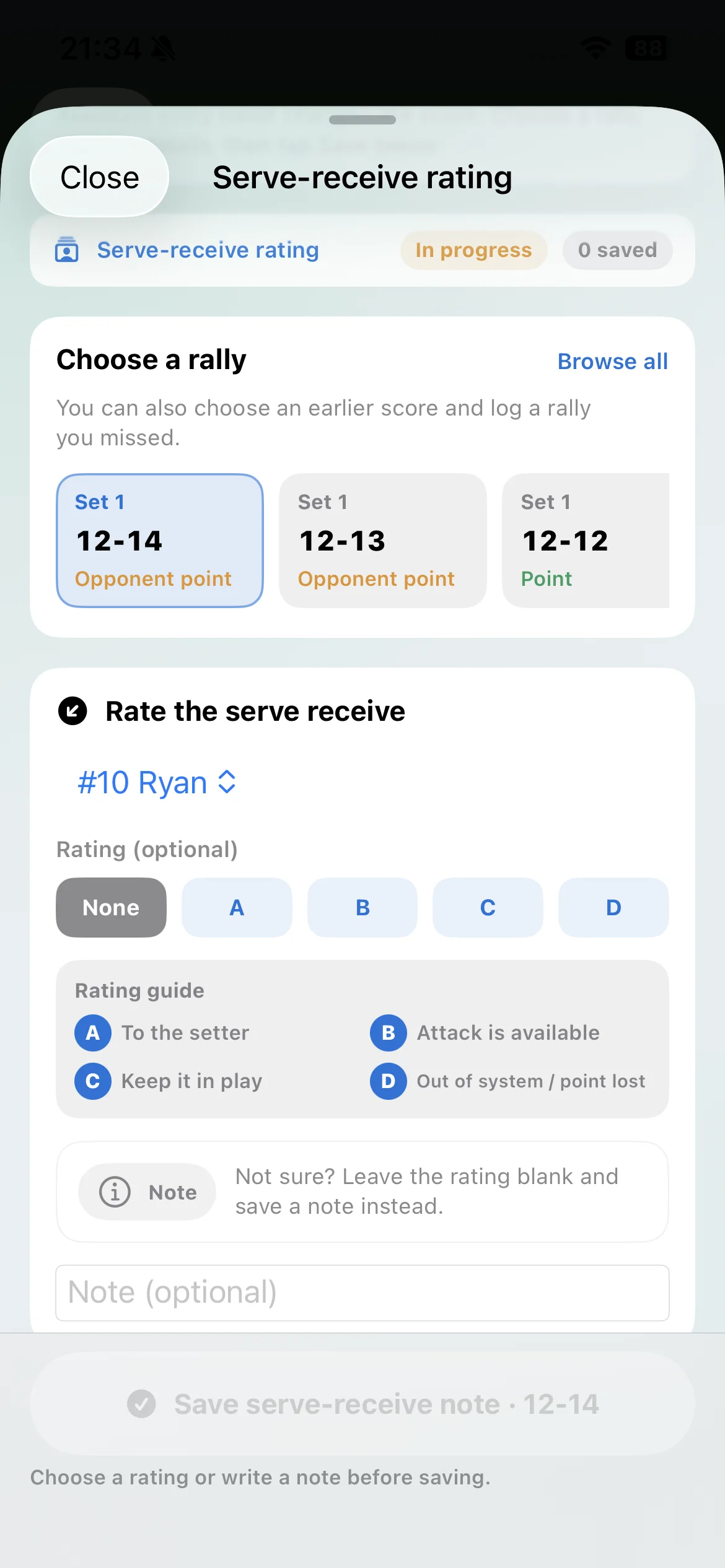
Vollyze uses a visible A-D guide: A returns to the setter, B keeps an attack available, C keeps the rally playable and D is out of system or a point loss. The app records the grade beside the selected player and rally. This browser calculator uses the numeric 0-3 convention; it does not silently convert app records.
How should a coach interpret the result?
Start with internal comparison rather than a universal benchmark. Opponent serve quality, age, competition level, receiving responsibility and the staff's grading threshold all change the number. A passer who handles the hardest seams may have a lower average than a teammate who receives fewer or easier balls.
- Compare the same rating guide across enough receptions.
- Separate a short set sample from a multi-match trend.
- Check whether the server targeted one player, seam or rotation.
- Review what the setter could run after the pass.
- Connect the reception grade to side-out, not only to appearance.
A falling average is a prompt to inspect context, not proof of one player's fault. The useful question is: which type of serve and receiving shape repeatedly removed the attack the team wanted?
Turn the rating into the next practice
Once the weak context is clear, write a practice response that recreates it. Name the serve target, the receiving responsibility and the attack the team should preserve. This is more actionable than asking the group to "pass better."
- Issue
- Seam serves reduced the number of in-system receptions in Rotation 5.
- Evidence
- The rating distribution shifted from 3- and 2-passes toward 1-passes across two matches.
- Practice response
- Repeat the same seam pressure and score the drill when reception keeps two attack options available.
The receiving team wins a point and the right to serve when it wins the rally, then rotates under rally scoring. That is why pass quality should ultimately reconnect to side-out and rotation context, not remain an isolated individual grade. See the FIVB basic rules for the game sequence and the Vollyze side-out guide for the receiving-phase calculation.
Frequently asked questions
How do you calculate volleyball passing average?
Multiply the number of 3-, 2-, 1- and 0-passes by each rating, add the points and divide by all serve receptions.
What does a 3-pass mean?
It usually means the reception keeps the setter and intended attack options available. Define the target area and available options with your own staff.
Are A-D and 0-3 ratings the same?
Not automatically. They can be mapped when the definitions match, but platforms and staffs may use different thresholds.
What is a good passing average?
There is no universal target for every level and opponent. Compare consistent samples from your own team and inspect what changed behind the number.
Keep the grade connected to the rally.
Vollyze records serve-receive context beside the score, then helps the staff turn the clearest team pattern into the next practice focus.