Free coaching tool
Volleyball hitting percentage calculator: measure attack efficiency without losing context
From the Vollyze product team. The calculator uses the NCAA hitting-percentage formula, then keeps kill rate, error rate and sample size visible for a more useful coaching review.
Volleyball hitting percentage, also called attack percentage or hitting efficiency, balances kills against attack errors across all recorded attempts. It answers a better question than kill count alone: how much terminal value did the attacker create after the cost of errors?
Use the calculator for the arithmetic, then inspect the reason behind the result. A low number caused by repeated out-of-system swings needs a different practice response from the same number caused by unforced errors on good sets.
NCAA formula
Hitting percentage calculator
Enter kills, attack errors and total attempts. The result updates as you type and checks that the counts can coexist.
- Kill percentage
- --
- Error percentage
- --
- Non-terminal attempts
- --
Add total attempts or load the example.
Formula (kills - attack errors) / total attack attempts
The short answer
Hitting percentage rewards kills and charges the attacker for errors.
A box-score value of .267 means the net of kills minus errors equals 26.7% of all attack attempts. Keep the numerator and denominator visible before judging the result.
- Calculate Subtract errors from kills.
- Compare Keep role and sample consistent.
- Coach Find the attack context to train.
What is hitting percentage in volleyball?
The NCAA defines hitting percentage as kills minus hitting errors, divided by total hitting attempts. A kill is an attack that directly results in a point. An error is an attack charged with directly ending the rally against the attacking team. Total attempts also include attacks that the opponent keeps in play.
Official reference: NCAA volleyball glossary and hitting-percentage formula.
How is volleyball hitting percentage calculated?
A player with 12 kills and 4 attack errors on 30 attempts has eight net kills. Divide eight by 30 to get .2666, then round to three decimals for the familiar box-score display: .267.
Kills and errors are already part of total attempts. Do not add them to the denominator again. In this example, 14 attempts were neither kills nor errors; the defense kept those attacks in play.
Why does a box score show .267 instead of 26.7%?
Volleyball statistics commonly display attack percentage as a decimal rounded to three places. The two formats describe the same rate:
- Box-score format
- .267
- Percentage format
- 26.7%
- Net result
- 8 more kills than errors across 30 attempts
A negative value is possible. Three kills and five errors on 20 attempts produces -.100. That does not identify the cause; it tells the staff where to inspect attack context.
Hitting percentage vs. kill percentage
Kill percentage is kills divided by attempts. Hitting percentage subtracts errors before dividing, so two hitters with the same number of kills can have different efficiencies.
- Kill percentage
- Kills / attempts. Shows how often an attempt ended in a kill.
- Error percentage
- Errors / attempts. Shows how often an attempt directly lost the point.
- Hitting percentage
- (Kills - errors) / attempts. Balances terminal success and cost.
USA Volleyball has emphasized the cost of hitting errors and the need to consider set quality and the block before asking hitters to swing harder. That is why the calculator shows kill and error percentages beside the combined result. Read more in USA Volleyball's coaching discussion of attack decisions and error cost.
What is a good hitting percentage?
There is no honest universal threshold for every player. Position, age, opponent, set location, transition load and out-of-system responsibility all change the difficulty of an attempt. Middles often receive different opportunities from pin hitters, while a high-volume outside hitter may be asked to manage difficult balls.
- Compare the same role over a visible number of attempts.
- Separate one short set from a multi-match trend.
- Review kill rate and error rate, not only the combined value.
- Check whether difficult rotations or poor first contact changed set quality.
- Distinguish unforced errors from controlled swings that kept a bad ball alive.
NCAA rankings publish kills, errors, total attacks and hitting percentage together rather than presenting the percentage without its counts. Use the same discipline with a school or club team. See the NCAA team hitting-percentage table for the box-score format, not as a universal youth benchmark.
How Vollyze keeps hitting efficiency connected to the match
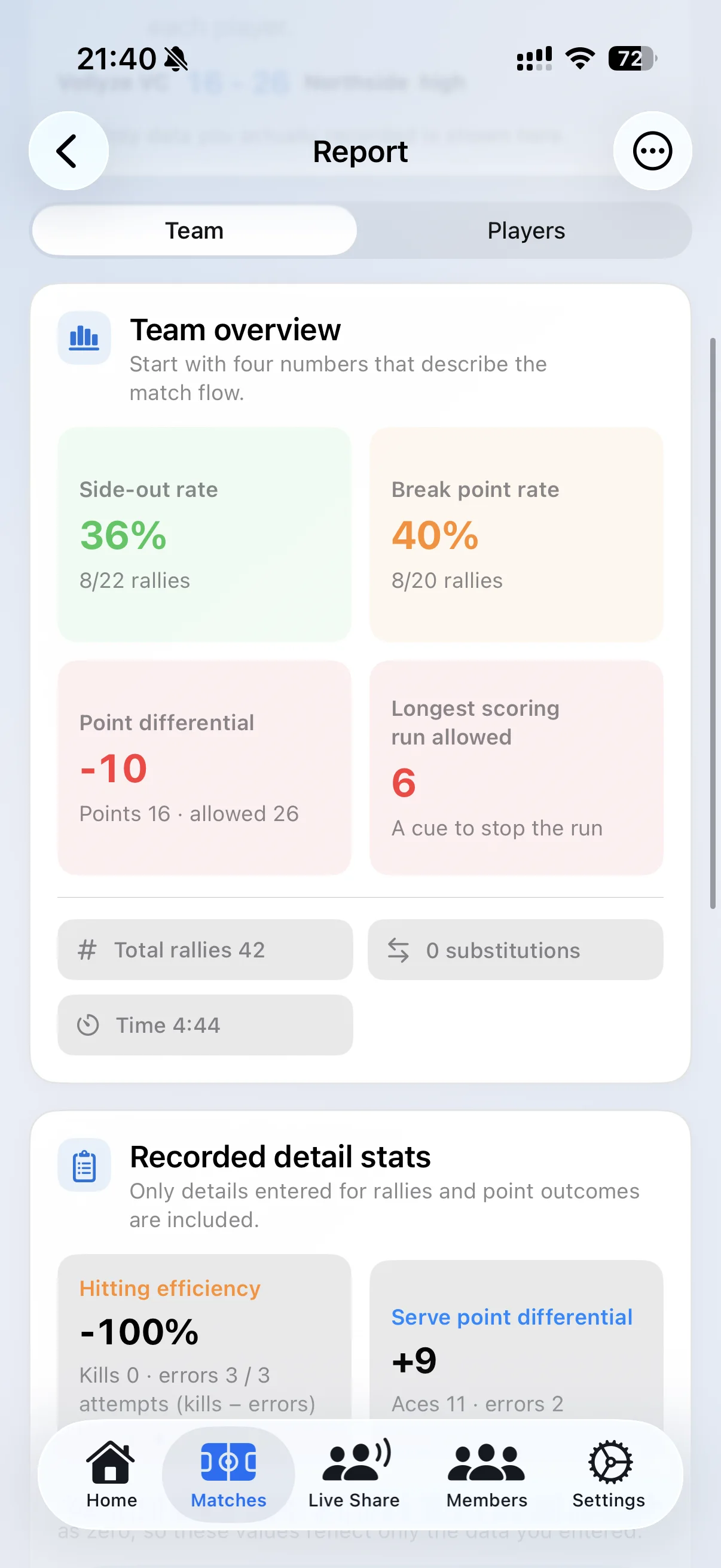
Vollyze begins with the score and lets the staff add detail when it is useful. When attack outcomes are recorded, the report can show hitting efficiency beside side-out rate, break-point rate, scoring runs and other match context. Missing rally detail is not treated as complete data.
Turn the result into the next practice question
Do not respond to every low hitting percentage with more isolated hitting repetitions. First identify which part of the result changed and where it happened.
- If error rate rose
- Review set quality, block context and whether the hitter had a controlled high-ball option.
- If kill rate fell
- Check shot predictability, transition timing and whether the offense still created one-on-one opportunities.
- If one rotation changed
- Recreate that first-contact and setter-position context in a game-like drill.
A useful practice target is specific enough to observe: "On out-of-system balls in Rotation 4, keep the error percentage below the previous match while creating a repeatable deep-corner option." The metric supports the decision; it does not replace the coach's view of the rally.
Frequently asked questions
How do you calculate hitting percentage?
Subtract attack errors from kills, then divide by total attack attempts.
Why is the result written as .267?
Box scores commonly show three decimal places. A .267 hitting percentage is the same as 26.7%.
Can hitting percentage be negative?
Yes. The result is negative when errors exceed kills in the recorded attempts.
Is kill percentage the same metric?
No. Kill percentage ignores errors; hitting percentage subtracts them.
What is a good hitting percentage?
Use role, level, opponent and sample context. Compare consistent records from your own team before applying an outside benchmark.
Keep the number connected to the rally.
Vollyze records the match first, adds attack detail when your staff needs it and helps turn the clearest team pattern into the next practice focus.