Free fillable serve-receive resource
Free volleyball serve-receive tracker and pass rating sheet
From the Vollyze product team. This guide connects a printable serve-receive rally log to the real A-D rating, live side-out context and post-match practice workflow available in Vollyze.
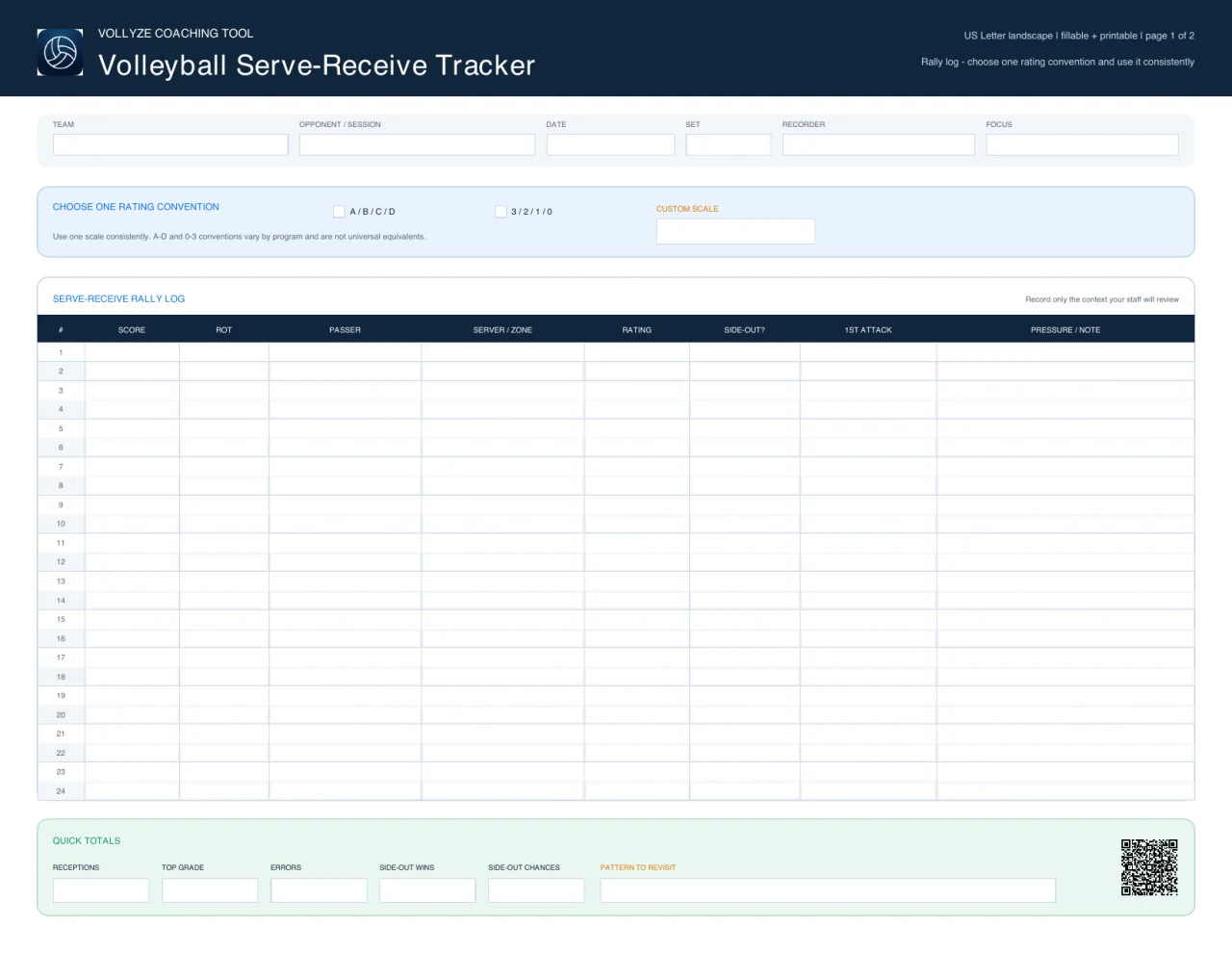
Free two-page fillable PDF
Download the serve-receive tracker
Choose A4 or US Letter. Type into the fields in a compatible PDF viewer, or print both landscape pages for the bench. No email or account is required.
- 24-rally serve-receive log
- A-D, 0-3 or custom rating convention
- Player and six-rotation summaries
- Issue, evidence and next-practice brief
2 pages | fillable fields | rally + summary views | no signup
- Which passer and rotation faced the most difficult pressure?
- Did the reception keep the intended attack available?
- Did the team eventually side out after the first contact?
- Which pressure pattern should be recreated at the next practice?
A volleyball serve-receive tracker gives the staff a consistent way to record what happened on the first contact. The grade matters, but it becomes more useful when it stays connected to the rotation, server or serving zone, first-attack opportunity and final side-out result.
The tracker is intentionally lighter than a professional scouting system. A youth, high school, club or community team can begin with one rating per reception. Add more context only when someone on the staff will use it after the match.
The short answer
Record the pass, then preserve enough context to train the cause.
Choose one rating convention before the match. Record the passer and grade first. Add rotation, serve pressure and side-out only when those details will change the next coaching decision.
- Minimum Passer + rating
- Useful context Rotation + pressure
- Outcome Side-out + first attack
What should a serve-receive tracker record?
The first page uses nine compact fields. That does not mean every field must be completed on every rally. Decide the question before the set, then collect only the evidence needed to answer it.
| Field | Question it answers | When it is worth recording |
|---|---|---|
| Passer | Who took responsibility for first contact? | Almost every rated reception. |
| Rating | How much offensive choice remained? | Every reception included in the sample. |
| Rotation | Did the pressure repeat in the same lineup context? | When the team is comparing six rotations. |
| Server / zone | Where did the pressure originate? | When serve location or server type is the coaching question. |
| First attack | Could the team run the intended offense? | When pass quality must connect to attack availability. |
| Side-out | Did the receiving team eventually win the rally? | When the staff wants the full receiving-phase outcome. |
A-D or 0-3: choose a convention before you track
Passing scales are coaching conventions, not universal rules of the game. A 0-3 system is common in many U.S. programs, but other staffs use A-D, 0-4, symbols or a custom definition. An AVCA study of NCAA tournament passing, for example, reports a 4.0 scale, while other research uses 0-3. That variation is why the worksheet asks the staff to choose and define its convention.
Do not convert A-D to 0-3 automatically unless your program has defined that mapping. The paired column headers on page 2 save space; they are not a claim that every A means 3 or every D means 0.
- Define the top grade
- State what offensive options must remain for the highest rating.
- Define the error grade
- Decide whether an ace, overpass and out-of-system ball share one category.
- Calibrate two recorders
- Rate a short video sample separately, compare differences and revise the definitions.
- Keep the scale stable
- Do not change the meaning halfway through the five-match sample.
Consistency is more valuable than false precision. A simple scale used the same way across a match gives the staff a more dependable comparison than a detailed scale that changes with each recorder.
How to use the tracker during a match
- Name one question. Examples include whether Rotation 5 survives short serves, whether a seam is repeatedly exposed or whether the team can build a first attack after an imperfect pass.
- Choose the scale. Check A-D, 0-3 or write the custom labels before the first serve.
- Record the passer and rating first. These are the minimum fields. Skip optional context if the recorder is falling behind.
- Add the pressure source. Use a server number, serve type or court zone only when the staff plans to review it.
- Mark first attack and side-out. Keep reception quality separate from the eventual rally result.
- Summarize after the set. Move player and rotation patterns to page 2 rather than trying to calculate everything between rallies.
USA Volleyball's serve-reception guidance emphasizes reading the server and training the action in game-like conditions. The tracker should support that coaching process. It should not turn a live set into a desk exercise.
Keep pass quality and side-out outcome separate
A strong pass can still end in a lost rally. A difficult pass can still produce a point. That is not a contradiction. The rating describes the first contact under the staff's definition; side-out describes whether the receiving team eventually won the rally.
Review the two signals together. If the top-grade rate is stable but side-out remains low, the next question may be the set or first attack. If both fall in the same rotation, the staff can investigate formation, seam responsibility or the server-zone matchup.
| Pattern | Possible question | Practice response to test |
|---|---|---|
| Pass quality down, side-out down | Is serve pressure preventing the planned offense? | Recreate the same server, zone and receiving rotation. |
| Pass quality stable, side-out down | Is the first attack selection or execution the constraint? | Start from a playable pass and train the first attacking decision. |
| One passer down, team side-out stable | Is the team covering the seam or simply avoiding the passer? | Use targeted serves without removing team responsibility. |
| One rotation repeatedly down | Is formation or available attack shape causing the problem? | Replay that rotation under the same serving pressure. |
Use the side-out percentage calculator and coaching guide when you need the rally-phase formula. Use the passing average calculator when your chosen scale is numeric.
Add the rating without changing the main score
Paper works well when one person owns a small sample. A shared digital workflow becomes useful when the main recorder must protect the score while another staff member captures selected serve-receive details.
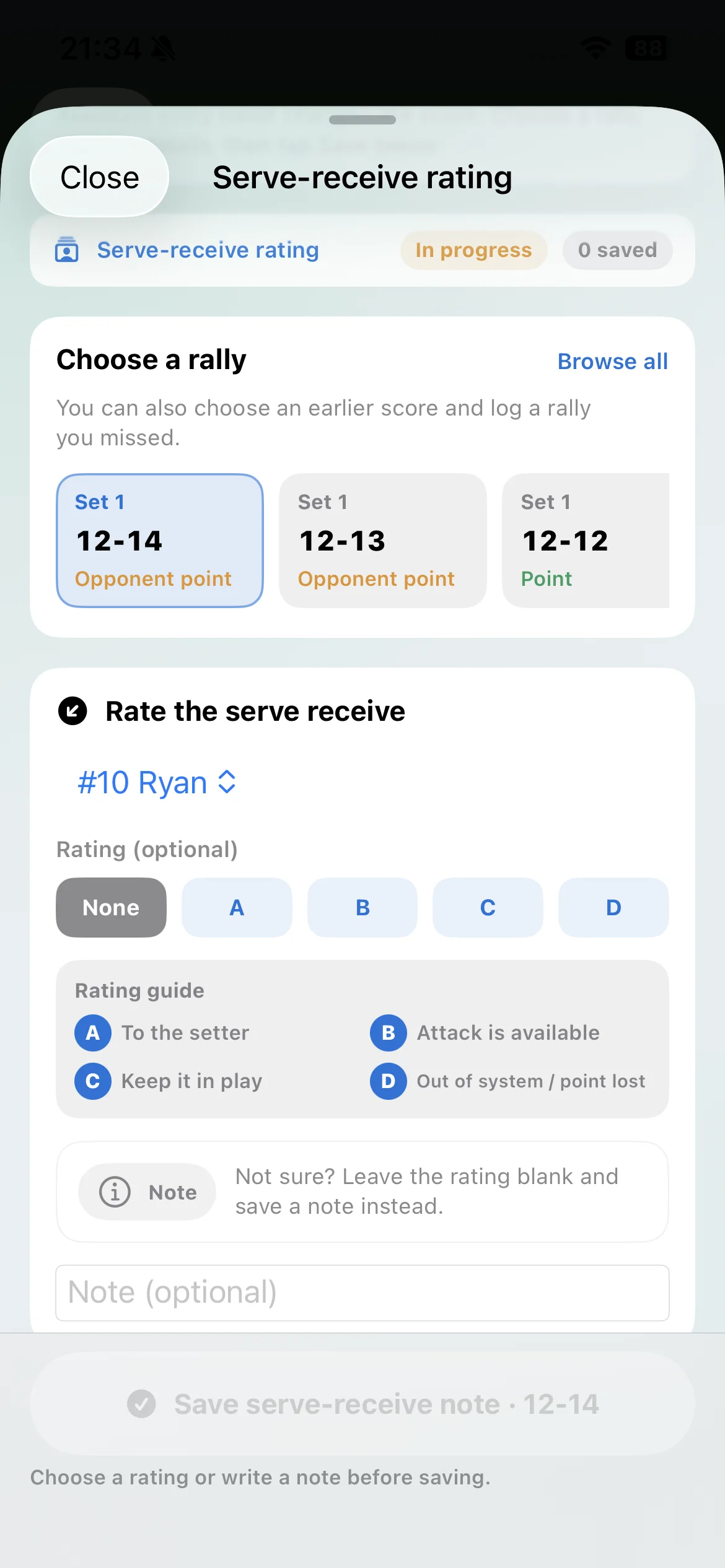
The main device remains responsible for points and match state. The assistant device can focus only on serve-receive ratings. After the entries are merged, the report can connect the rating sample to side-out and rotation context. That division of responsibility is often easier to sustain than asking one person to code every action.
Where Vollyze fits
Use the worksheet to define the question, then test the same workflow live.
- Main score
- One device owns points, sets and match state.
- Assistant entry
- A second device adds only selected reception ratings.
- Team review
- Pass quality stays connected to side-out and rotation context.
- Next practice
- The staff leaves with one issue, evidence and response.
Free plan: record and review up to five matches on iPhone before deciding whether a paid individual or shared-staff workflow fits.
Turn the summary into one practice decision
Page 2 ends with three fields: issue, evidence and next practice. Keep each answer short enough to read during a staff conversation.
- Issue
- Rotation 5 loses offensive shape against short serves into the seam.
- Evidence
- Six rated receptions; four limited first attack and three failed side-outs.
- Next practice
- Serve short into the same seam, require an organized first attack, then score the side-out.
- Success check
- Repeat the sample and compare the same rating and side-out definitions.
The purpose is not to label a passer from a small sample. It is to identify a repeatable team situation. The free volleyball practice plan template can turn that situation into a timed, game-like session.
Frequently asked questions
What should I record first?
Record the passer and one rating. Add rotation, server or zone, first attack and side-out only when they answer a chosen coaching question.
Should I use A-D or 0-3?
Use the system your staff understands and define it before tracking. The scales vary and are not universal equivalents.
How do I calculate passing average?
For a numeric scale, multiply each rating count by its value, add the points and divide by total rated receptions. Keep error treatment consistent.
Why include side-out?
The rating describes first-contact quality. Side-out shows the final receiving-phase outcome, so the staff can avoid treating one grade as the whole rally.
Can I type into the PDF?
Yes. Both formats have fillable fields and can also be printed for handwriting.
Start with one reception question in your next match.
Use the free worksheet on paper, or download Vollyze in English to keep the rating connected to the live score, side-out context and next practice.