Free formation worksheet and coaching guide
Volleyball serve-receive formations: compare 2, 3, 4 and 5 passers
From the Vollyze product team. This guide compares coverage choices without prescribing one universal formation. The free planner keeps legal order, passer responsibilities, setter movement and the next coaching decision together.
- Choose the number of primary passers from the players and serves in front of you.
- Keep legal rotational order separate from the shape used to receive.
- Name short balls, deep seams and setter-release responsibilities before the match.
- Plan all six rotations because the available passers and attackers change.
- Evaluate the formation with pass quality, side-out and rally evidence.
A volleyball serve-receive formation describes how a team covers the court and assigns first-contact responsibility while receiving serve. Coaches often name the shape by the number of primary passers: five, four, three or two. The number alone does not tell you whether the formation is good.
A useful choice answers four questions: who owns each lane, where the setter releases, which attackers should be free from first contact and what the team does when the serve breaks the preferred shape. The answer can change by rotation, opponent and level.
Free two-page fillable PDF
Download the serve-receive formation planner
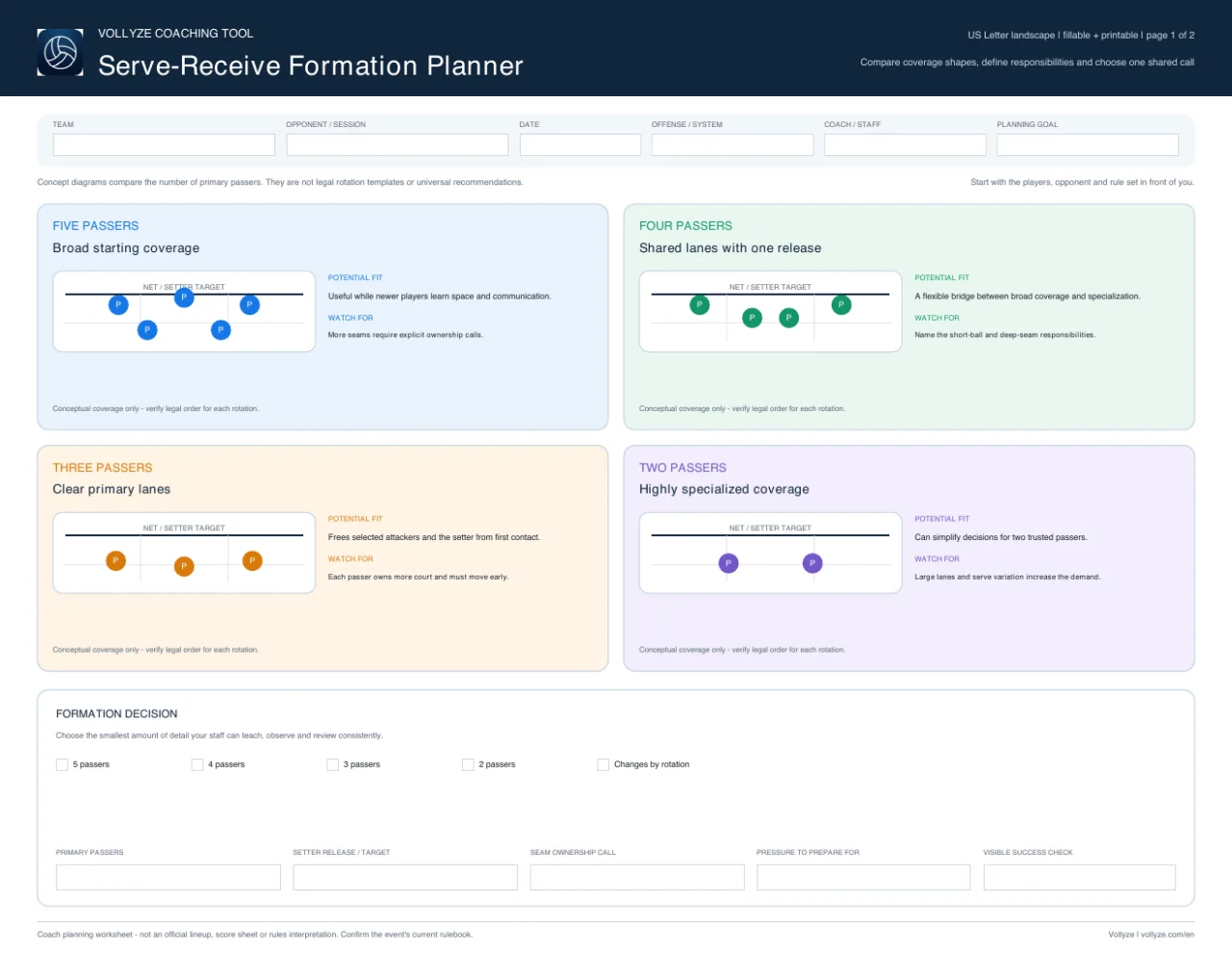
Compare coverage on page 1, then plan R1 through R6 with legal order, passer lanes, setter release, seam call and first attack on page 2.
- Concept diagrams for 2-, 3-, 4- and 5-passer choices
- Six rotation panels with fillable player and staff-call fields
- Issue, evidence and one formation or practice change
- No account, email address or sign-up form
Use landscape orientation. This is an unofficial coaching worksheet, not an official lineup sheet or rules interpretation.
The short answer
Use enough passers to cover the serve without making responsibility unclear.
More passers can reduce the space each athlete must cover. Fewer passers can free hitters and simplify primary lanes. Both choices create tradeoffs.
- Coverage Can the passers reach the serve?
- Clarity Who owns every seam?
- Offense What first attack remains available?
Compare 2-, 3-, 4- and 5-passer formations
The diagrams below show conceptual coverage only. They do not represent a legal starting order for every rotation, and they do not prescribe exact player locations. Use them to compare responsibility density before drawing your own rotation-specific shape.
- Potential fit
- Developing teams that benefit from broad starting coverage and shorter individual movement.
- Watch for
- More seams, more voices and uncertainty over who takes the ball.
- Potential fit
- A flexible bridge when one player should release but three passers do not yet cover enough court.
- Watch for
- Short-ball ownership and deep seams between staggered lanes.
- Potential fit
- Specialized passers can own clear lanes while selected attackers and the setter release.
- Watch for
- Larger court responsibility, late movement and servers changing depth or seam.
- Potential fit
- Two trusted passers can simplify the call and keep more attackers out of reception.
- Watch for
- Very large lanes, targeted fatigue and short-deep serve variation.
How many passers should your team use?
Start from capability and purpose, not fashion. A three-passer shape is not automatically more advanced or effective. If it creates late movement and untouched seams, a four- or five-passer plan may produce a more stable first attack. If an additional passer blocks an important approach and rarely touches the ball, reducing the group may help.
| Question | Evidence to use | Formation response to test |
|---|---|---|
| Can the primary passers reach short and deep serves? | Movement quality, untouched balls and late contacts. | Add coverage or change starting depth before changing the entire offense. |
| Which attackers should be available immediately? | Approach interference and first-attack options after reception. | Release the player whose reception role removes the most useful attack. |
| Are seams producing hesitation? | Aces between passers, double movement and unclear calls. | Reduce overlapping responsibility or define a stronger ownership rule. |
| Can the setter reach the target safely? | Collision paths, late release and passes that cross the setter's route. | Adjust the starting shape or target without hiding the legal order. |
| Does the same plan fit all six rotations? | Rotation-specific side-out and first-attack availability. | Keep shared language but adjust personnel or lanes by rotation. |
Legal starting order and serve-receive shape are different
The starting lineup establishes rotational order. A serve-receive shape describes where players prepare to pass and how they release into offense. A diagram can look tactically sensible and still violate the positional relationships required by the rule set in use.
The current FIVB Official Volleyball Rules 2025-2028 describe starting lineup and rotational order. FIVB has also announced rule tests for selected 2026 competitions, including timing related to receiving-team movement. A test in one competition is not permission to use the same interpretation everywhere.
Before official competition: confirm the governing body, age group, competition regulations and referee interpretation that apply. Use the organizer's official lineup sheet. The diagrams and downloadable planner on this page are coaching aids.
Plan the formation in all six rotations
The setter changes location, front-row attackers change and a libero may replace a different middle as the team rotates. That is why one attractive formation screenshot is not a complete plan. Map each rotation and keep the staff language consistent.
- Write the legal starting order. Use P1 through P6 before drawing any stack or release.
- Mark the primary passers. Name the players and the space each owns.
- Draw the setter's release. Check that the path does not create a collision or erase a passer's lane.
- Name short and deep seams. Use one call that players can repeat under serve pressure.
- Choose the intended first attack. The formation should preserve an offensive option, not only keep the serve off the floor.
- Write a fallback. Decide what changes when a server repeatedly beats the preferred shape.
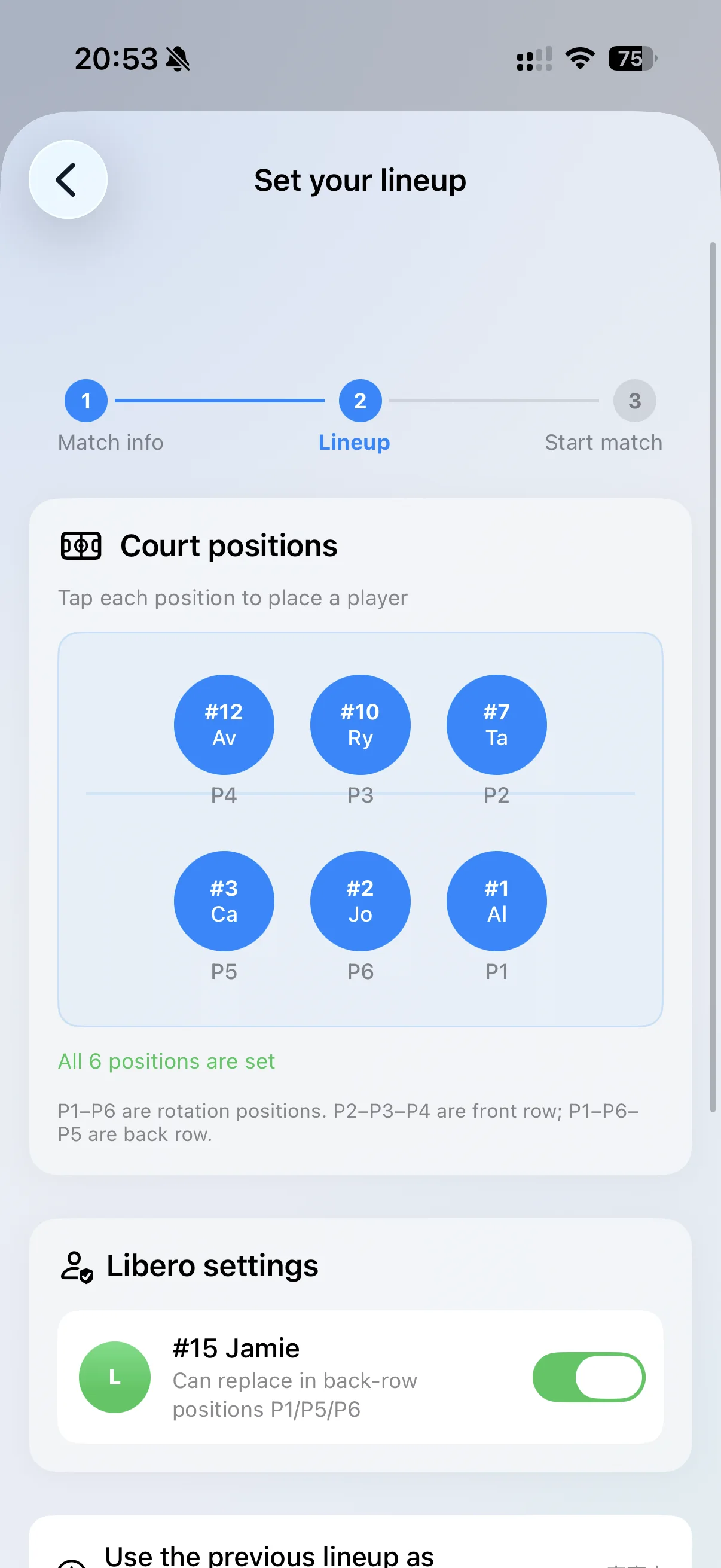
Use the separate volleyball rotation tracker and printable lineup planner when the immediate job is teaching P1-P6 or reviewing rotation performance rather than designing reception coverage.
Evaluate a formation with rally evidence
Passing average alone cannot tell you whether the formation worked. Keep the reception grade separate from the rally outcome, then inspect both. A difficult pass can still produce a side-out. A good pass can still lead to a poor attack decision.
- Issue
- The short seam between two primary passers repeatedly produced late movement in R5.
- Evidence
- Three low reception grades and two lost side-out rallies came from the same serving target.
- Response
- Move one passer forward, give that seam one owner and rehearse the first attack that follows.
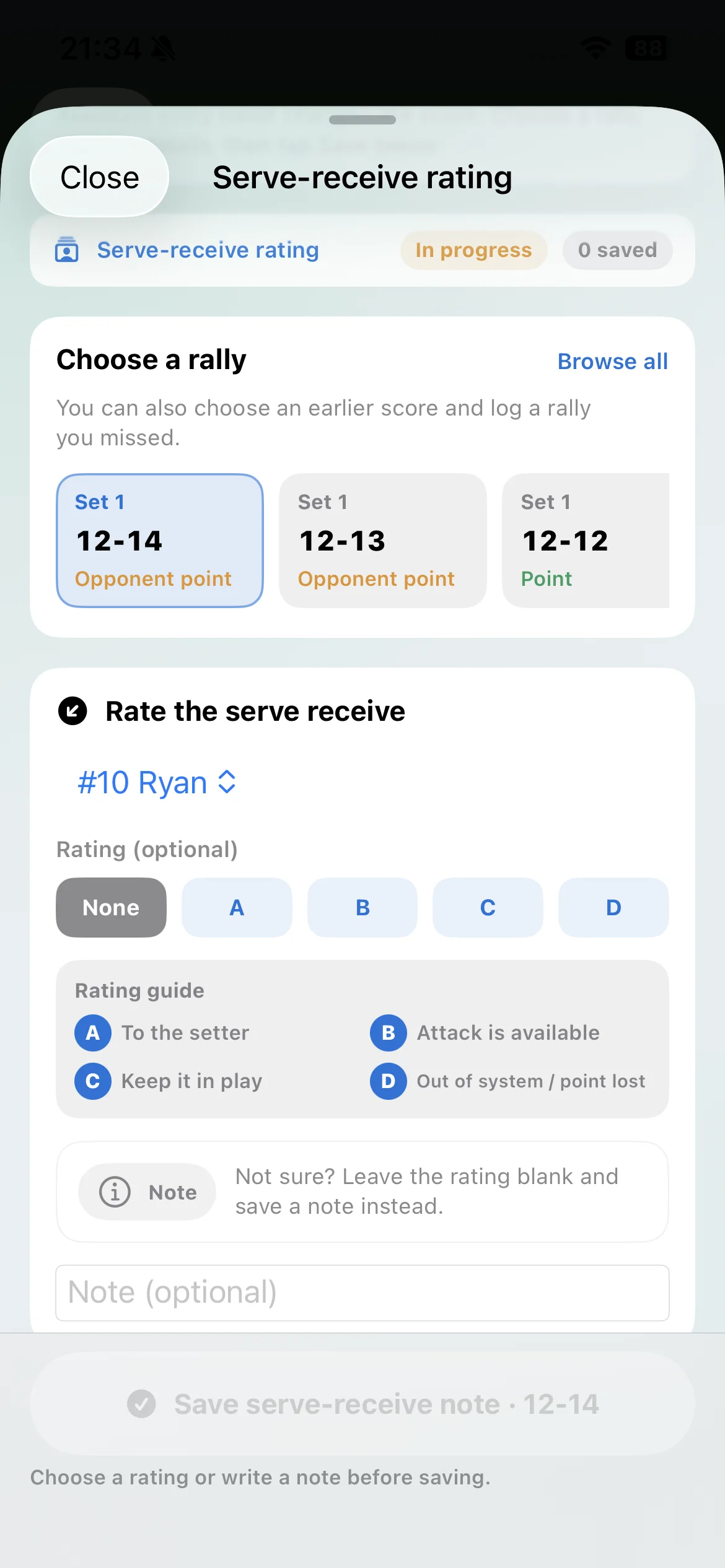
The free serve-receive tracker records passer, rotation, serve pressure, rating, first attack and side-out on the same rally row. Use the formation planner before the match and the tracker during it.
Where Vollyze fits
Plan on paper, observe the formation live and carry one response into practice.
- Before the match
- Set the starting lineup and libero so the recorded rotation has a reliable reference.
- Primary entry
- Keep the score, service state, current rotation and point context on one authoritative device.
- Assistant entry
- Add serve-receive ratings, player notes or attack paths without changing the score.
- Live view
- See side-out, break-point and recent rallies while the set is still active.
- Post-match
- Open the rotation and rally evidence behind the formation problem.
- Next practice
- Save one focused response rather than replacing the whole system after one weak set.
Teach the formation in game-like conditions
A whiteboard proves that players can recognize a shape. It does not prove that they can move, call seams and preserve an attack against a real serve. Walk through the legal order first, then add servers, scoring and consequences that reproduce the problem.
USA Volleyball's serving guidance discusses targeting seams in a three-person serve-receive formation. Use that pressure from the opposite side of the net: name the seams your servers will attack, then make the reception group solve them with the planned call.
Keep the serve target and rotation constant long enough to test one responsibility change. Then vary depth, pace or seam.
Frequently asked questions
What is a serve-receive formation?
It is the coverage shape and responsibility plan a team uses when receiving serve. It should keep legal order, passers, seams, setter movement and the intended first attack clear.
How many passers should a team use?
There is no universal best number. Choose from personnel, serve pressure, offensive goals and what the team can communicate reliably.
Is three-passer serve receive always better?
No. It can free attackers and clarify primary lanes, but each passer owns more court. The tradeoff must fit the team and opponent.
Does the same formation work in every rotation?
Not necessarily. Setter location, front-row options, libero use and available passers change, so teams often adjust the shape while keeping the same calls.
Is the PDF an official lineup sheet?
No. It is a fillable coaching planner. Use the required official form and current rulebook for competition.
Give every seam an owner before the next serve.
Use the free planner to define the formation, then record one match in Vollyze to see which rotation and serve pressure deserve the next practice response.