Free rotation sheet and analysis guide
Volleyball rotation analysis: tracker and printable six-rotation planner
From the Vollyze product team. This guide includes a free A4 and US Letter planning sheet plus the English lineup, live-match, report and practice screens now available on the App Store.
- Download the free A4 or US Letter sheet without an account or email form.
- Use a visual planner when the goal is teaching positions and movement.
- Use a live tracker when the current lineup must stay with the score.
- Use rotation analysis when the staff needs to explain repeated pressure.
- Choose a workflow that turns the finding into a trainable situation.
A volleyball rotation tracker app can mean several different things. Some tools teach where players move in a 5-1 or 6-2 volleyball rotation. Some keep the current server, lineup and substitutions beside the score. Others compare what happened when the same rotation returned. Those are different coaching jobs, and the best choice depends on the question your staff needs to answer.
Volleyball rotation analysis is useful because the same lineup context returns throughout a set. It can reveal where a team repeatedly loses side-out, struggles to create a first attack or allows a scoring run. It becomes misleading when the staff treats the rotation number itself as the cause.
A result such as "Rotation 3 was minus five" is a starting point. It does not explain whether the problem came from serve pressure, a reception seam, the setter taking first contact, a limited front-row option, a blocking matchup or a small sample of difficult rallies. Good analysis reconnects the number to the game.
The short answer
Map R1-R6 before the match, then use rotation data to locate a trainable situation.
The worksheet makes the lineup visible. The match record shows which repeated condition deserves review.
- Plan Who is in each position?
- Locate Where did pressure repeat?
- Train What can the team rehearse?
Free printable PDF
Download the Volleyball Six-Rotation Planner
One landscape page for R1 through R6, player or jersey entries, system notes, libero planning and one post-match review question.
- Blank positions work with 5-1, 6-2, 4-2 and custom systems.
- Separate files are sized for US Letter and A4 printers.
- No email address, account or sign-up form is required.
Use landscape orientation at 100% or “fit to printable area.” This is a coach planning worksheet, not an official lineup or match-submission form.
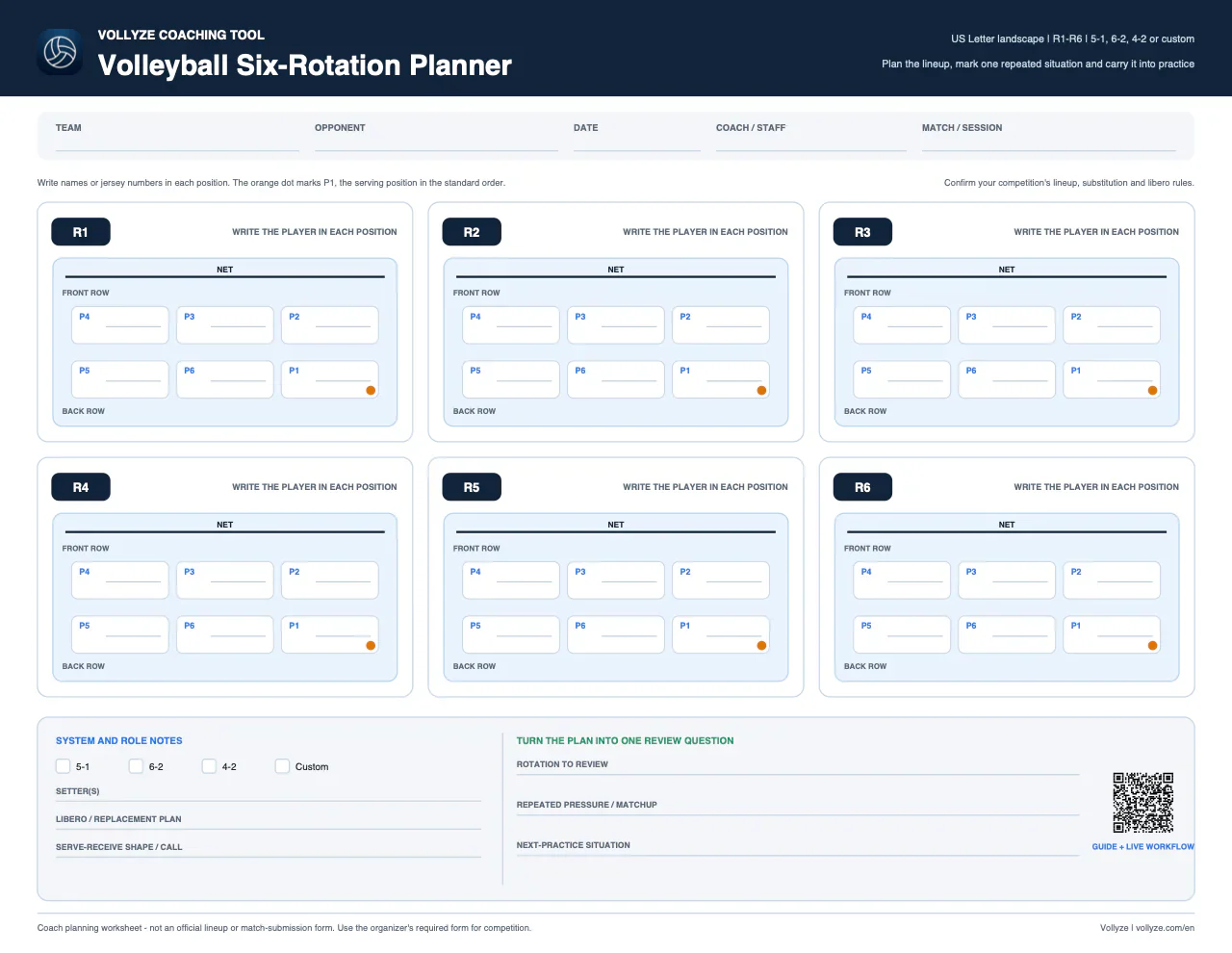
How to use the six-rotation planning sheet
The court labels follow the standard position numbers: P1 is right-back, P2 right-front, P3 middle-front, P4 left-front, P5 left-back and P6 middle-back. The orange dot marks P1 as the serving position in the standard order.
- Choose a consistent R1 reference. Some programs define R1 by the setter in P1. Others begin from the first lineup they expect to use. Write down the convention your staff will follow.
- Fill every position in R1. Use a jersey number, surname or short player code that the entire staff recognizes.
- Move each player clockwise. Map the next five panels in order and add the libero or replacement plan in the notes area.
- Add only the tactical note that matters. Record the serve-receive shape, setter call or matchup the staff needs before first serve.
- Finish with one review question. After the match, name the rotation, repeated pressure and next-practice situation worth carrying forward.
For official competition: use the lineup sheet, substitution rules, libero rules and device policy supplied by the governing body or event organizer. The printable planner is for coaching preparation and review.
Vollyze rotation workflow
Lineup setup, live context and post-match analysis in one iPhone app
- Best fit
- School, club, youth and community programs that want rotation context without a full video-analysis system.
- Before the match
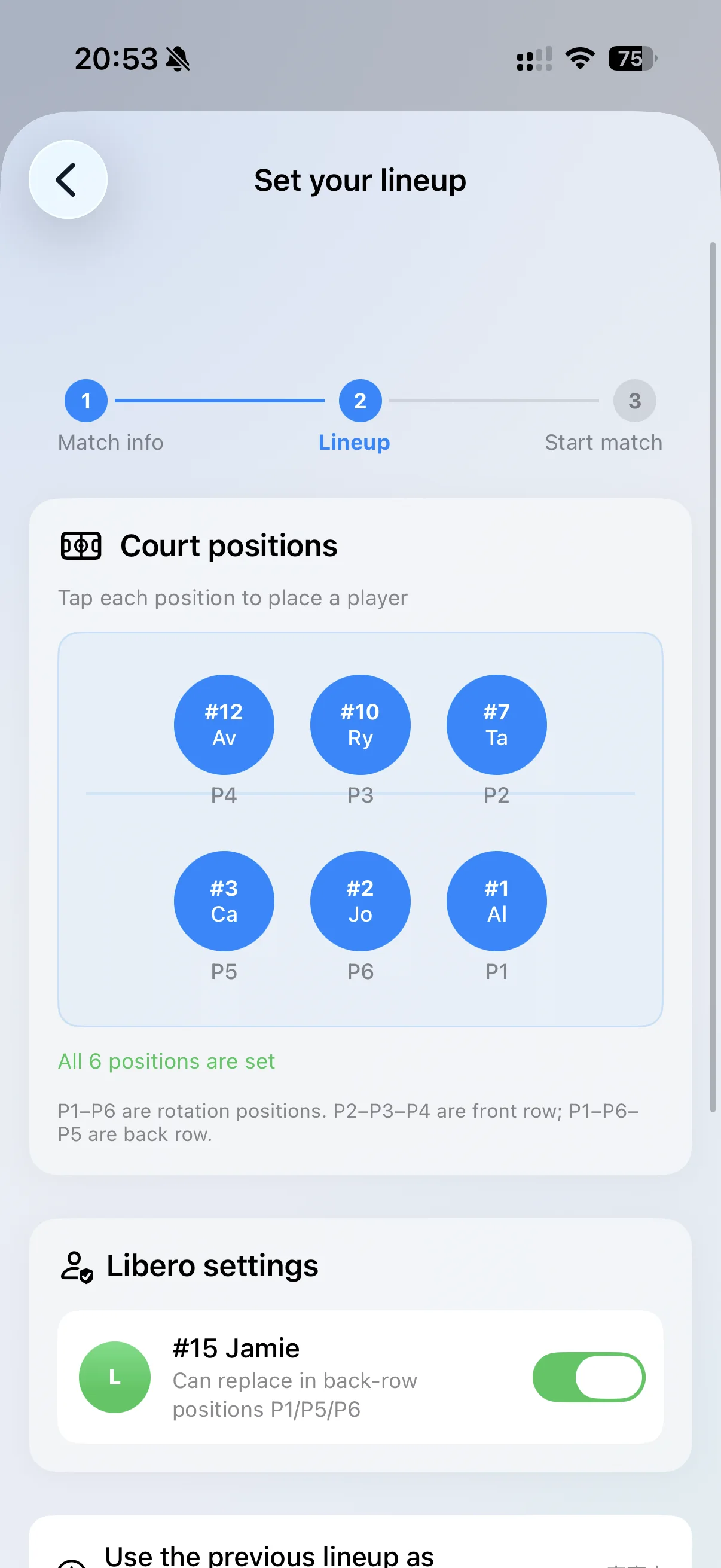
- Set the six-player starting lineup and libero so the recorded rotation begins from a reliable reference.
- During the match
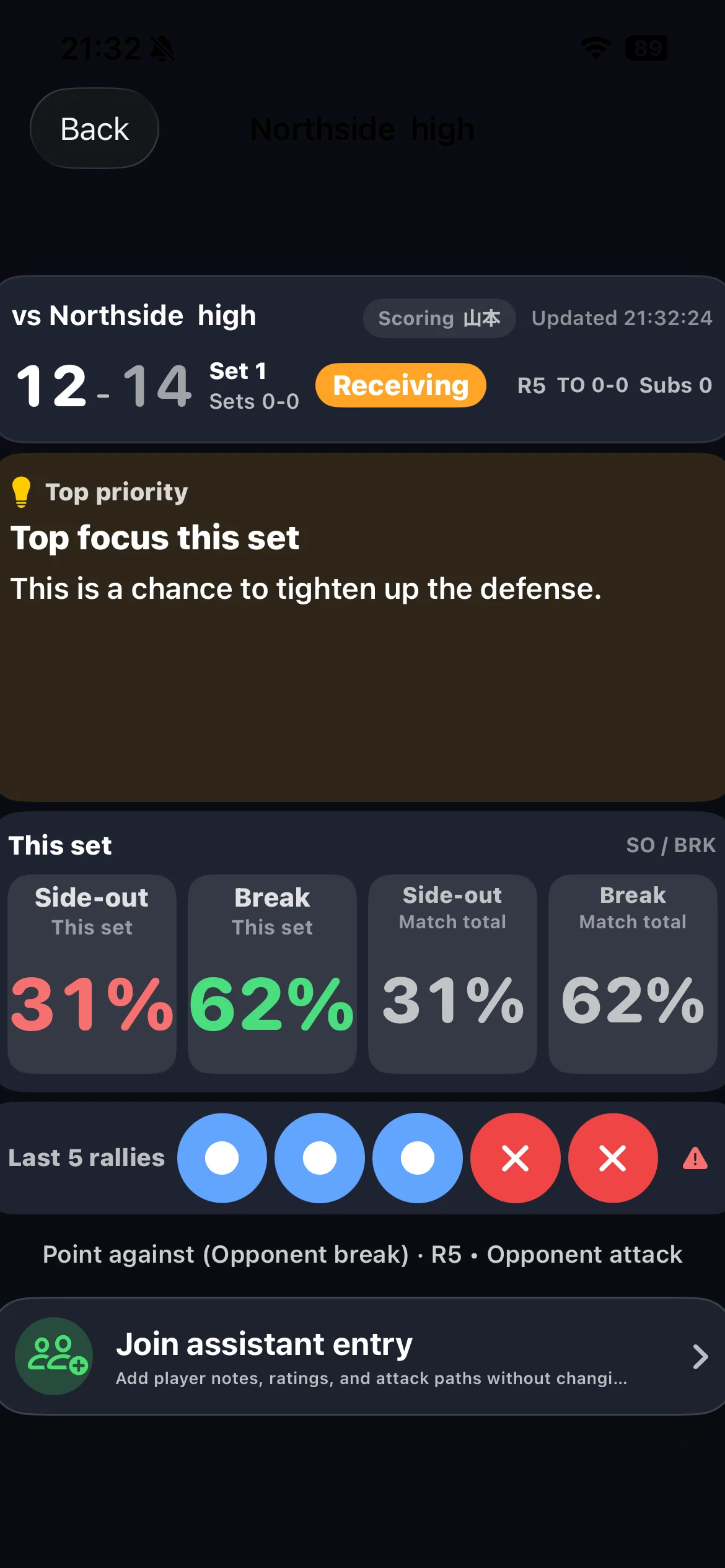
- Keep score, service state, current rotation, substitutions, side-out, break point and recent rallies connected.
- After the match
- Find the lineup context behind scoring pressure, then open the rallies and team evidence that explain it.
- Next decision
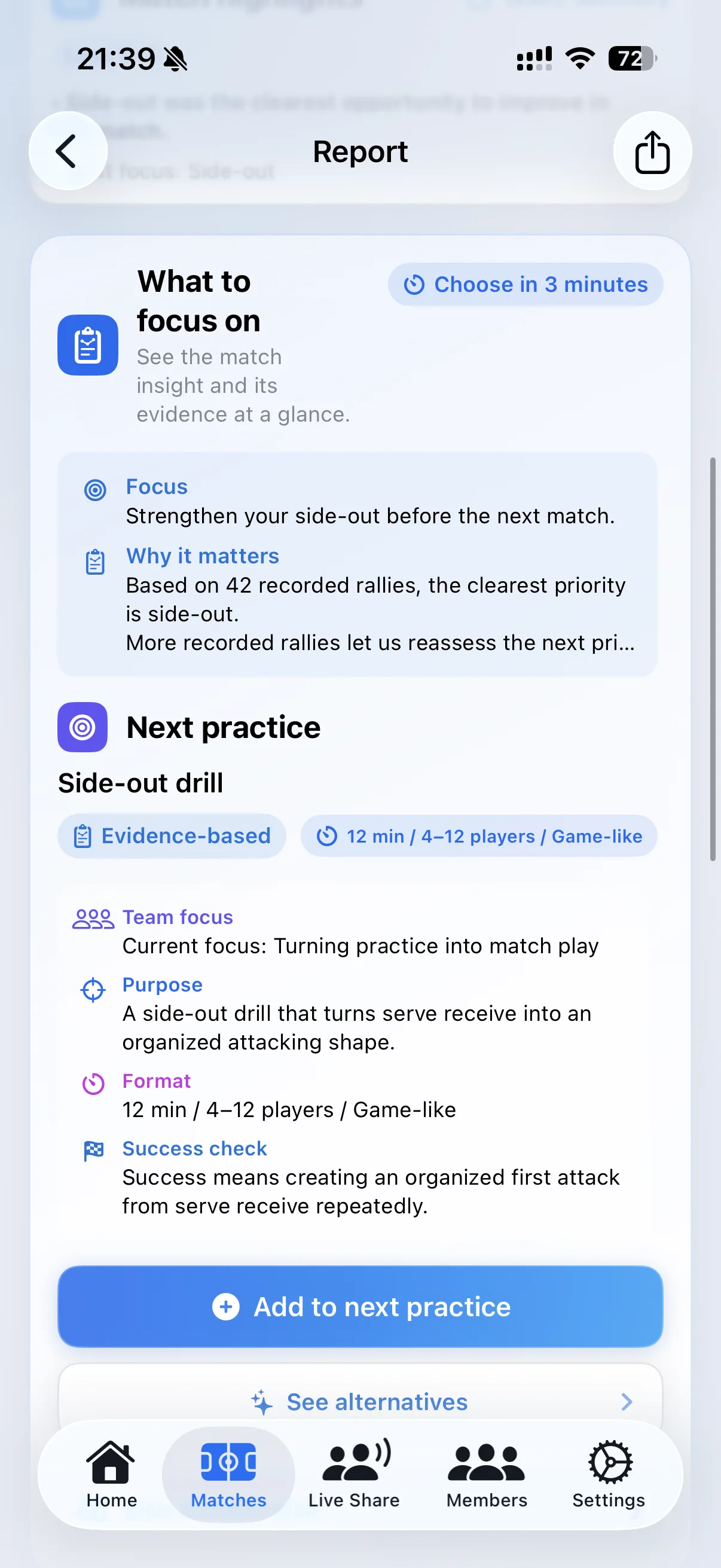
- Convert the repeated situation into one practice focus instead of stopping at a rotation ranking.
- Starting point
- Free on iPhone for up to five recorded matches. English is available on the App Store.
Choose a dedicated visual planner first if your main need is animated rotation teaching, drag-and-drop formation diagrams or automatic overlap checking. Vollyze is built around match recording, live context and post-match coaching decisions.
Which type of volleyball rotation tool do you need?
The phrase “rotation tracker” covers three different workflows. A coach may need more than one, but the distinction prevents a feature-rich tool from solving the wrong problem.
| Tool type | Best for | What it should show | Important limit |
|---|---|---|---|
| Visual rotation planner | Teaching serve-receive positions, base defense and movement | Formation diagrams, player movement and rotation templates | Usually does not explain what happened in a recorded match. |
| Live rotation tracker | Keeping the current lineup and service order with the score | Server, rotation, substitutions, score and timeout context | Tracking alone may not identify why a run happened. |
| Rotation analysis workflow | Reviewing repeated pressure and choosing a coaching response | Side-out, break point, score flow, first contact and rally evidence | Requires a reliable lineup and enough recorded rallies. |
Vollyze combines lineup setup, live rotation context and post-match analysis. It is not designed as an animated rotation-teaching board. That boundary matters when comparing apps.
What a volleyball rotation tells you
Under the FIVB rules, a team has a rotational order based on its starting lineup, and the receiving team rotates clockwise when it wins the right to serve. Once the serve is contacted, players may move into their playing positions subject to the rules that apply to the rally. The FIVB provides both the current Official Volleyball Rules and a basic rules overview.
For analysis, a rotation therefore identifies a repeatable lineup and service-order context. It does not freeze every player in one spot for the whole rally. Your review should account for the serve-receive formation, transition movement and tactical responsibilities that follow the serve.
Start with service state and score flow
The same rotation can behave differently while serving and receiving. If the team is receiving, ask whether it can side out. If it is serving, ask whether it can create and convert break-point opportunities. Always read the rotation beside the score flow.
Five questions to ask before calling a rotation weak
| Question | Evidence to inspect | Possible practice response |
|---|---|---|
| Was the team serving or receiving? | Side-out or break-point context for the rallies. | Train the relevant phase instead of a generic six-on-six drill. |
| What happened on first contact? | Reception grade, seam pressure and setter availability. | Recreate the serving target and first-ball responsibility. |
| Which attack remained available? | Front-row options, out-of-system choices and attack path. | Build a repeatable high-ball or first-attack solution. |
| How did the run start? | Last rallies, point-loss reasons and score margin. | Practice the first response after one point against. |
| Is the sample large enough? | Rallies, sets and matches recorded in that context. | Mark it for observation before changing the system. |
A practical rotation review after the match
- Find the largest negative run. Begin with a moment that changed the set rather than ranking all six rotations immediately.
- Confirm service state. Separate a side-out problem from a serving and defense problem.
- Open the relevant rallies. Review first contact, available attack, point-loss reason and staff notes.
- Check whether the pattern repeats. Compare later appearances of the same rotation and avoid conclusions from one unusual rally.
- Name the trainable situation. Describe the serve, formation, first contact and next action that practice should reproduce.
- Retest it in the next match. Use the same definition so the staff can see whether the response improved.
Read the team overview before opening player detail
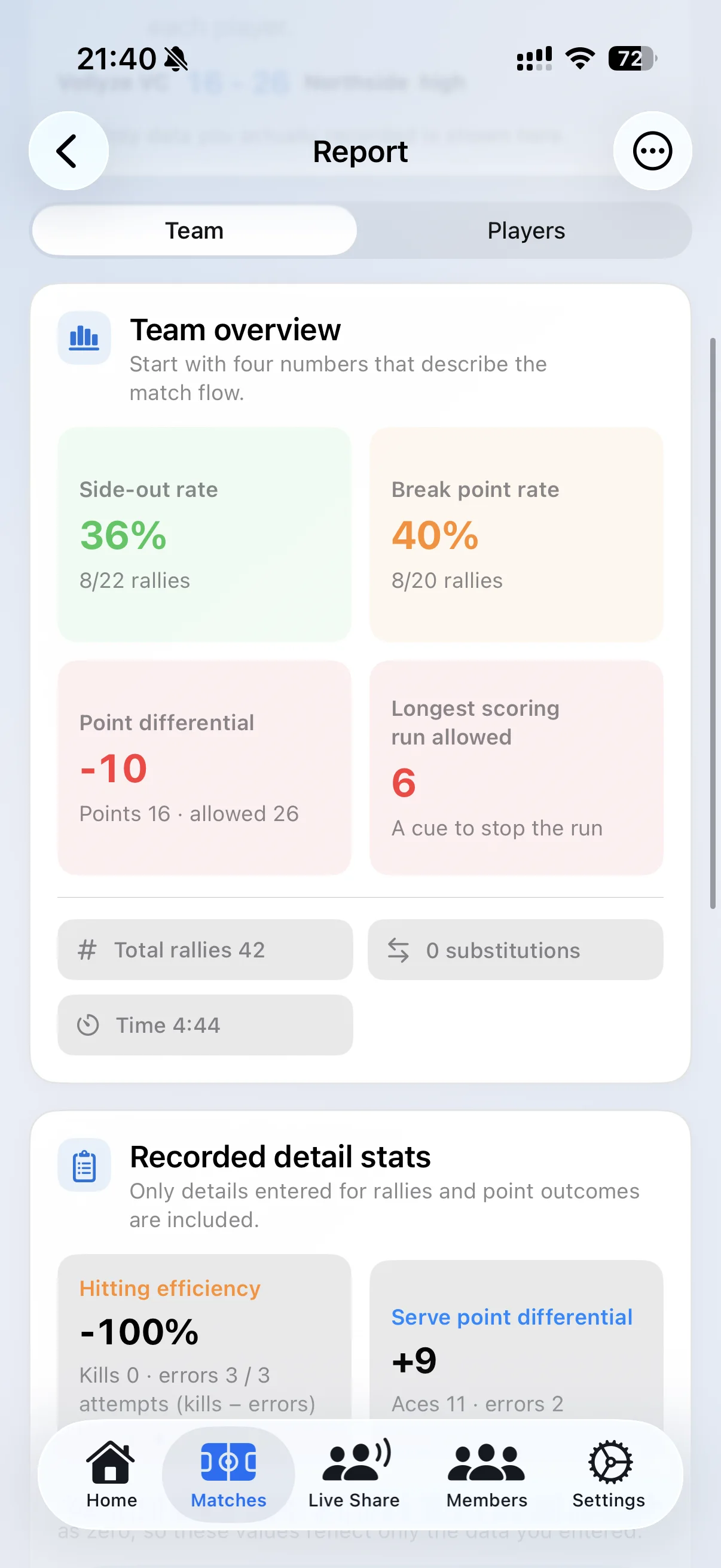
A team-level overview gives the staff a stable starting point. Side-out rate, break-point rate, point differential and the longest scoring run allowed show where to look. Individual records can then explain a specific rally or responsibility without turning the review into a player ranking.
Turn the rotation finding into a decision brief
Use language that describes the situation rather than blaming a position group. "R4 is bad" gives practice nowhere to go. A useful brief names the issue, evidence and response.
- Issue
- Side-out became unstable in R4 when the serve targeted the seam between two passers.
- Evidence
- The longest run against began there, and the intended first attack was unavailable on three recorded rallies.
- Practice response
- Recreate the seam serve, clarify first-ball responsibility and connect the pass to the first available attack.
Treat one match as evidence, not a permanent label
A small sample can still be useful. It tells the staff what to inspect and what to watch next. It should not become a permanent judgment about a rotation or player. Opponent serve quality, lineup changes, substitutions, score pressure and recording completeness can all change the result.
Use simple confidence language in staff meetings: observed once, repeated in this match, repeated across matches or stable enough to plan around. This keeps the strength of the conclusion proportional to the evidence.
Where Vollyze fits
Vollyze connects the starting lineup and live score with side-out, break point, recent rallies, selected player detail and the next practice focus. It is designed for everyday team analysis rather than professional opponent scouting or frame-by-frame video coding.
If your staff needs a lighter way to answer "where did the pressure repeat and what should we train?", the workflow is a good fit. If you need detailed setter distribution by every zone, synchronized multi-angle video and custom scouting reports, evaluate a specialist analysis platform.
Frequently asked questions
What is a volleyball rotation sheet?
It maps the six players across the six rotational contexts so the staff can plan position, serving order, libero replacements and short tactical notes.
Is this an official lineup sheet?
No. It is a coaching worksheet. Use the official form and procedures supplied by your competition for match submission.
Can it be used for 5-1, 6-2 or 4-2?
Yes. The six player spaces are blank, so the sheet works with those systems or a custom lineup.
How do players move through R1-R6?
Use one consistent starting reference, then move each player one position clockwise in the rotational order for every following panel.
What is volleyball rotation analysis?
It compares team performance across recurring lineup contexts, then inspects what happened in the rallies behind the result.
Does a weak rotation mean the lineup is the problem?
No. The rotation locates a context. Service pressure, first contact, attack availability and matchups still need to be reviewed.
What should a coach review first?
Start with score flow and service state, then first contact and the repeated point-loss pattern.
How many matches are needed?
One match can identify a useful question. Repeated matches are needed before treating the result as a stable trend.
Is Vollyze a visual rotation planner?
Vollyze sets the six-player lineup, keeps rotation context connected to the live score and supports post-match review. It is not an animation-first teaching or automatic overlap-checking tool.
Connect the rotation to the rally that explains it.
Download Vollyze in English and use one match to move from score flow to one trainable situation.