Volleyball match analysis
Volleyball match analysis template and coaching workflow
From the Vollyze product team. This guide is based on the live scoring, staff entry and reporting workflow shown in the real English-localized screens below.
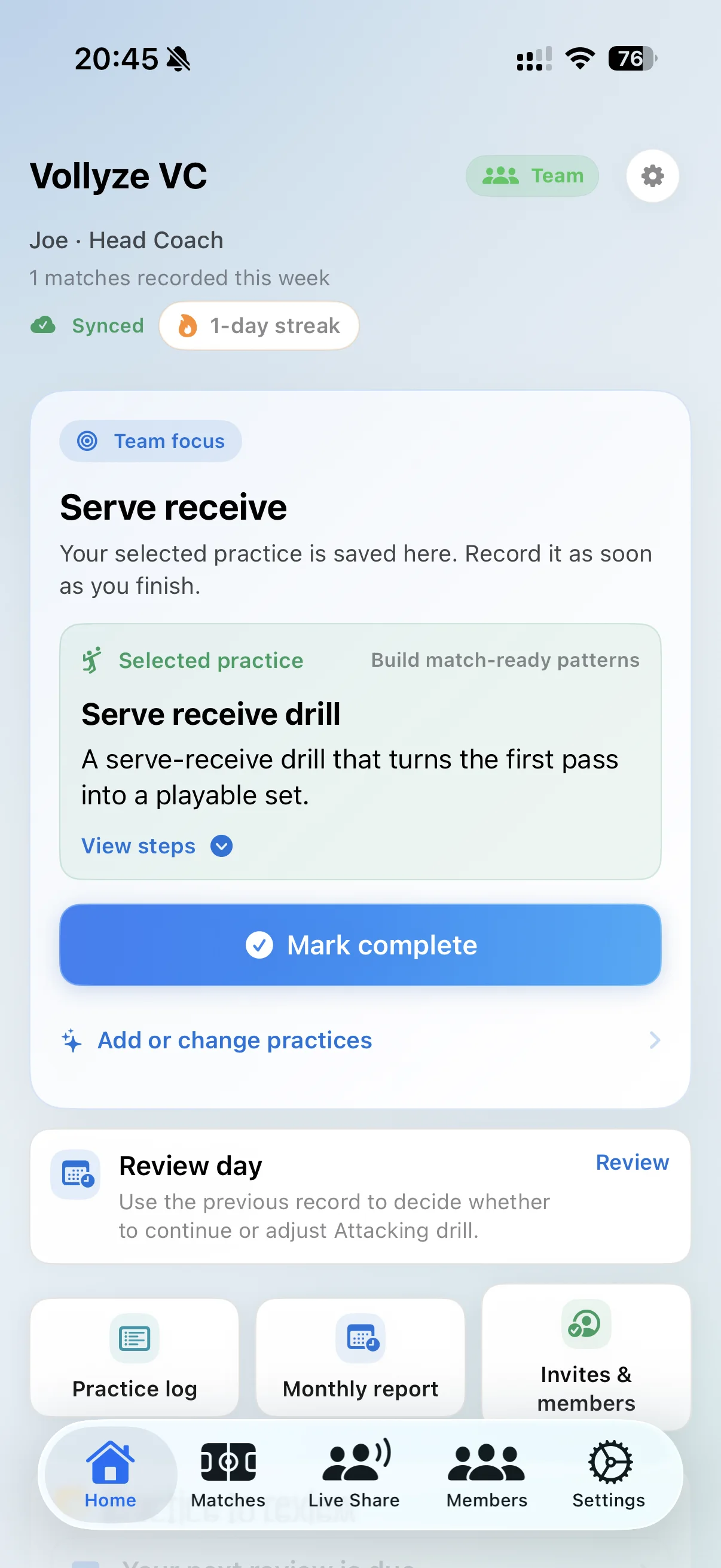
- Start with one team question that can change the next practice.
- Review serve receive, rotation context and point-loss runs as a connected story.
- Let one person own the score and ask other staff to add only useful supporting detail.
- Use the free one-page worksheet when the staff needs a printable or fillable review.
- Finish with one practice priority, not a long list of statistics.
Volleyball match analysis is often described as collecting statistics. That is only the first part of the job. The useful part is deciding what the team should do with the information while the match is still fresh.
For most school, club and youth teams, the question is not whether they can create more data. It is whether the head coach, assistant coach and manager can look at the same evidence and agree on the next training priority. A practical workflow needs to work on a busy bench, fit inside a short post-match conversation and still make sense when the staff reviews it again at the next practice.
The short answer
Analyze the pattern that changes what you coach next.
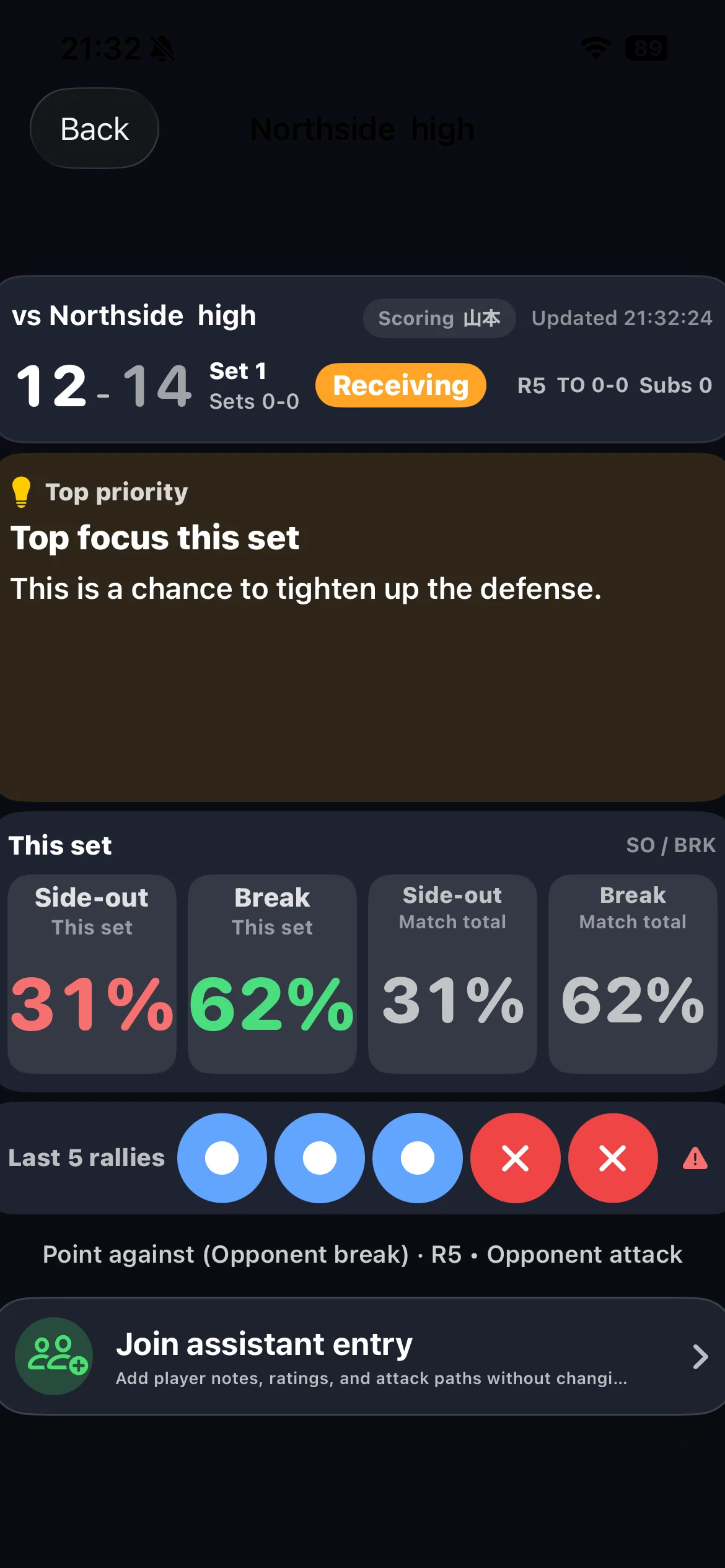
Start with the smallest useful set of signals: the score and result, serve receive and side-out context, point-loss streaks, rotation pressure and a few staff observations. Then choose one priority that the next practice can actually address.
- During match Keep the record moving.
- After match Find the clearest team pattern.
- Next practice Train one response to it.
Free coaching resource
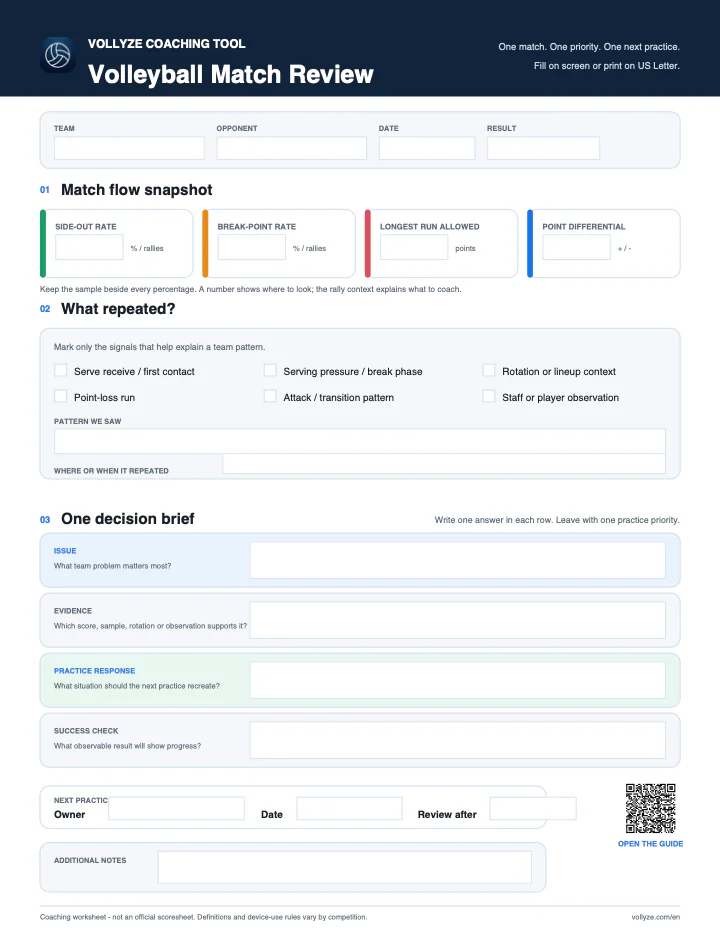
Download the Volleyball Match Review Worksheet
A one-page, fillable PDF for coaches who want to turn one match into one clear staff decision.
- Capture score flow, side-out, break-point and rotation context.
- Mark only the signals that actually repeated during the match.
- Leave with one issue, one piece of evidence and one practice response.
No sign-up required. Fill it on screen or print on US Letter. This is a coaching review tool, not an official scoresheet.
Start with a coaching decision, not a spreadsheet
A full scouting system can be valuable for teams with dedicated analysts and a clear process for using every metric. Many teams do not need to begin there. If the recording task is too broad, the person holding the phone stops seeing the match. If the report has too many charts, the staff leaves the gym without knowing what to train.
Before choosing what to record, decide what you would like to know when the set ends. Good first questions include:
- Did our serve receive give us a playable first attack, or did the first contact create the same problem repeatedly?
- Did a run of opponent points begin in one rotation, with one type of error or after one tactical change?
- What is the one situation we can recreate at the next practice to give the team a better answer?
These questions make the workflow smaller and more honest. You do not need every attack location or every individual rating to notice that the team is failing to side out after poor first contact, or that one lineup loses its rhythm when the opponent serves a certain zone. Add detail only when it helps explain the pattern.
Five signals that are useful for a team review
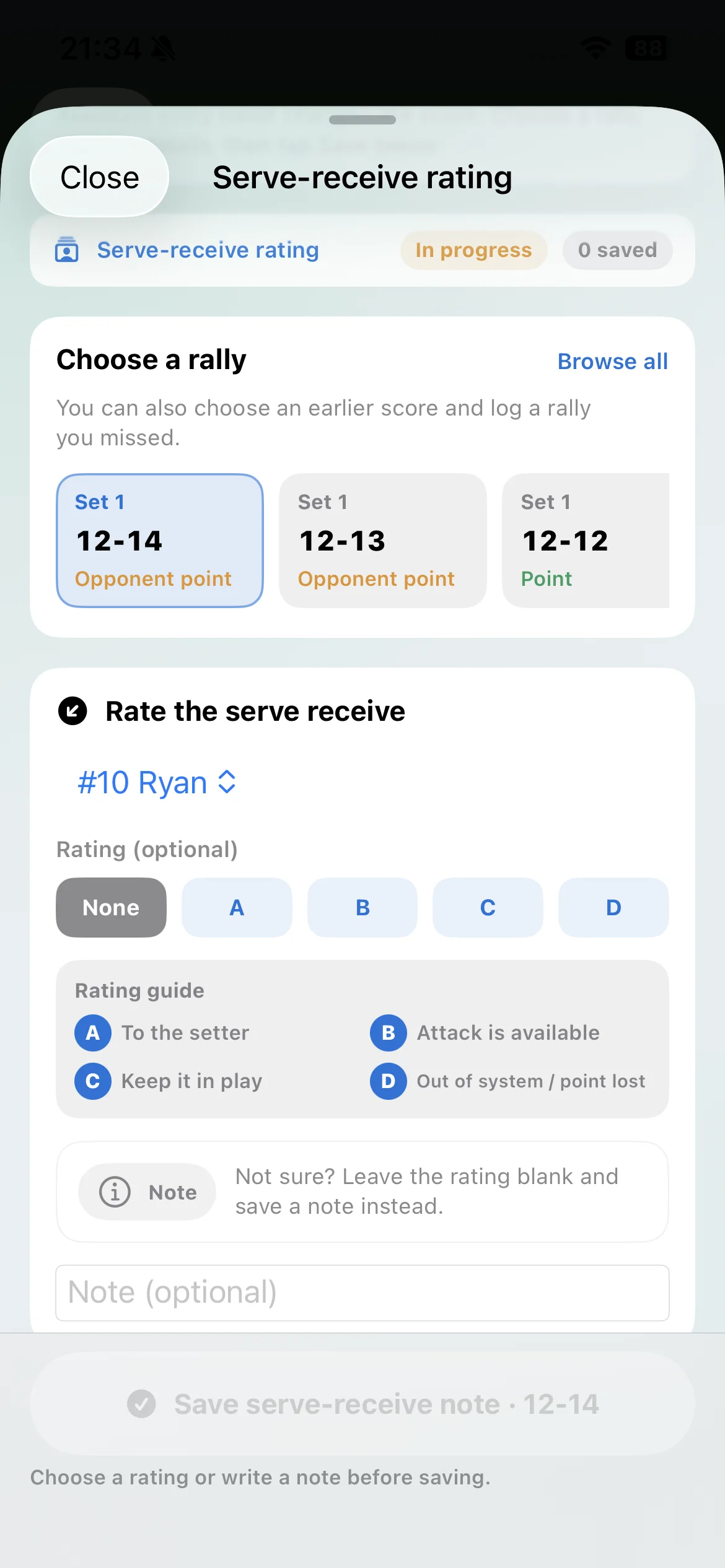
Serve receive: ask what the first contact enabled
Serve receive is one of the most useful places to begin because it connects directly to the first attack. A pass can look acceptable while still limiting the setter's options, slowing the offense or forcing an emergency ball. Conversely, a difficult pass can still lead to a successful side-out when the team makes a good transition decision.
That is why an A, B, C or D reception grade should be discussed with what followed. Did the team side out? Did the opponent get a long serving run? Did one receiver or one target zone appear in the key rallies? This turns a reception grade into a coaching question rather than an isolated player score.
Rotation analysis: use the lineup as context
A rotation can reveal a genuine team problem, but it should not become a shortcut for blaming players. The useful question is not simply, "Which rotation is bad?" It is, "What happens in this lineup that makes the same pressure harder to solve?"
For example, a rotation may expose a receiver to more serves, reduce the team's preferred attacking options or create a predictable transition pattern. Pair the rotation with the point-loss reason, serve receive result and score flow. The staff then has a more precise situation to recreate: the same server, the same lineup, the same first-contact challenge and a clearer response.
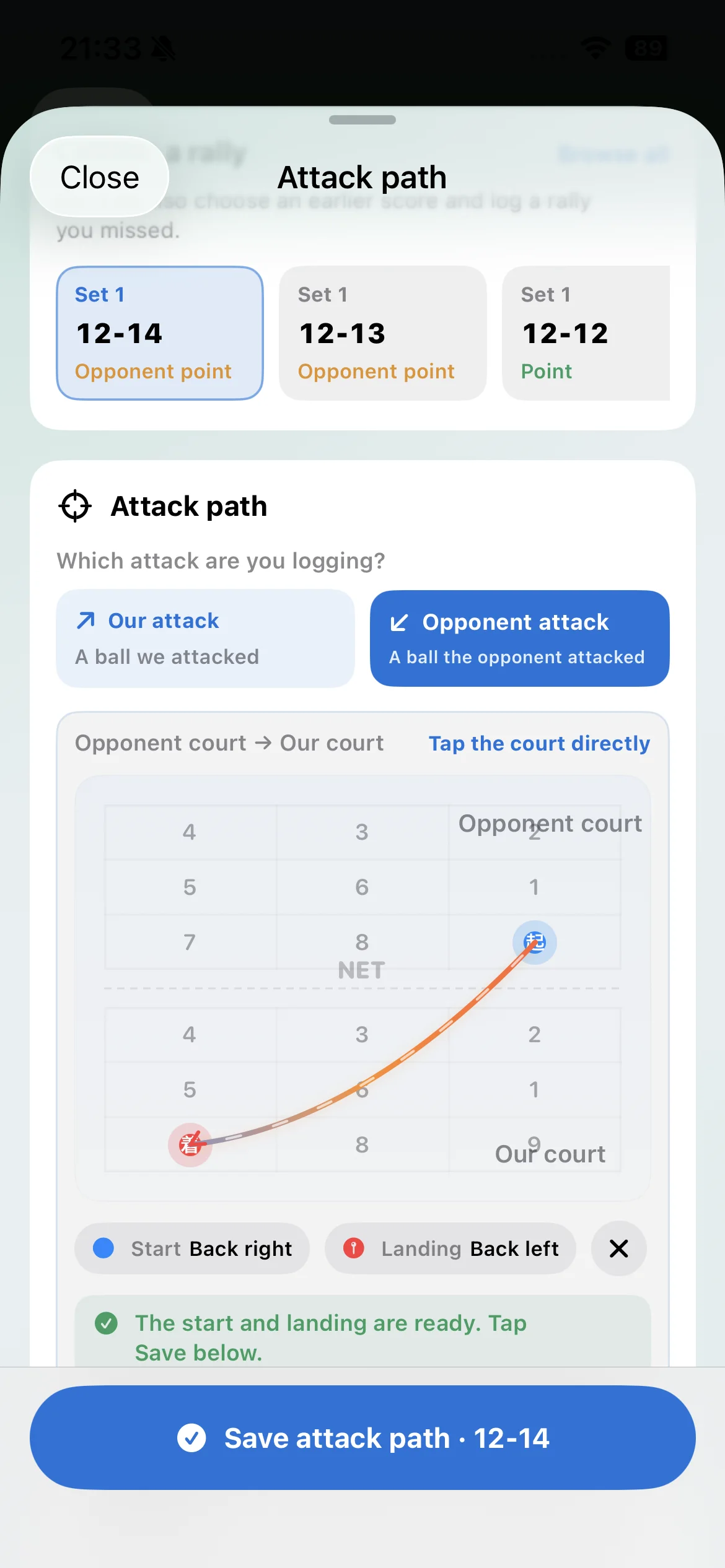
Use attack path only when it changes the decision
Shot location is useful when the staff needs to understand a repeated pattern, such as an attack landing in the same zone or a difficult first contact forcing the same option. It is not a requirement for every rally.
A shared workflow: one score, useful supporting input
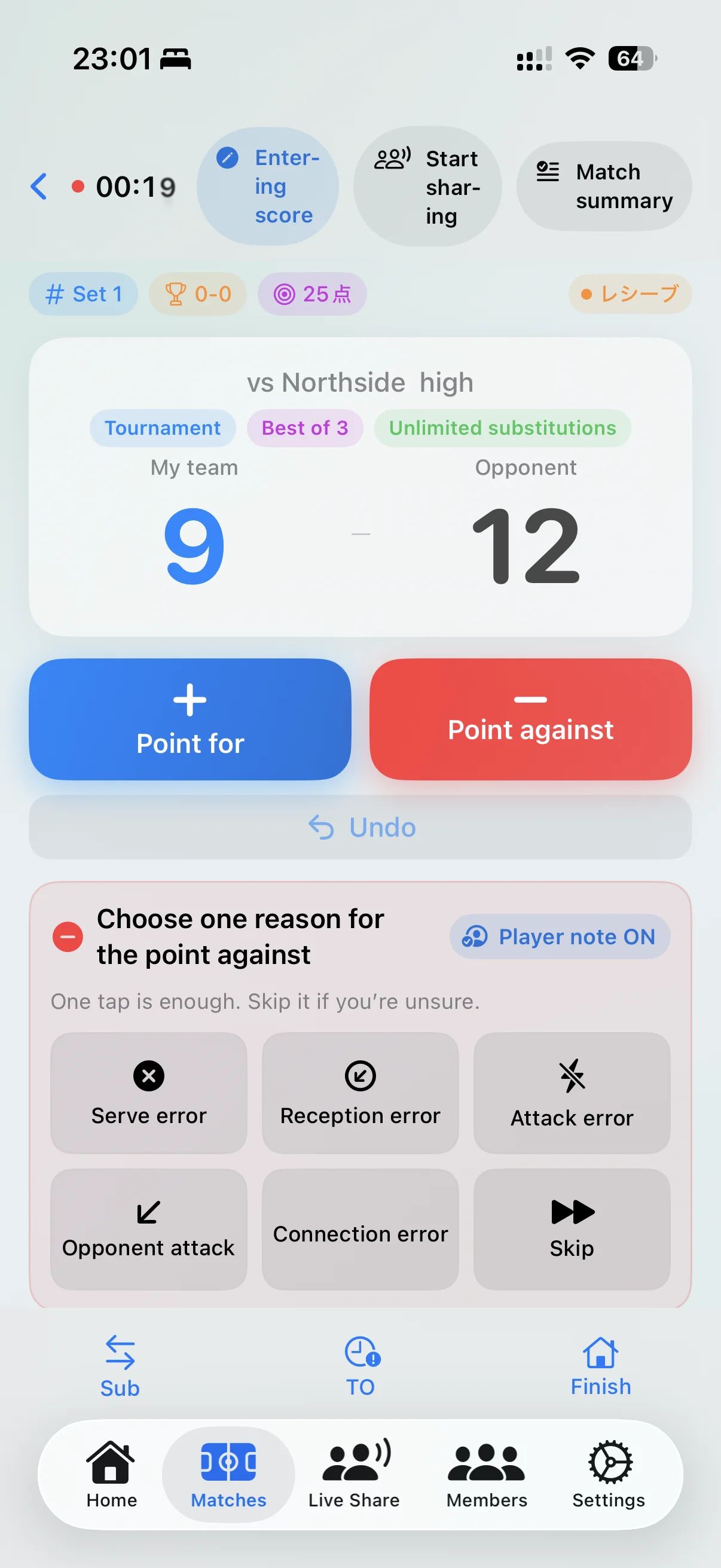
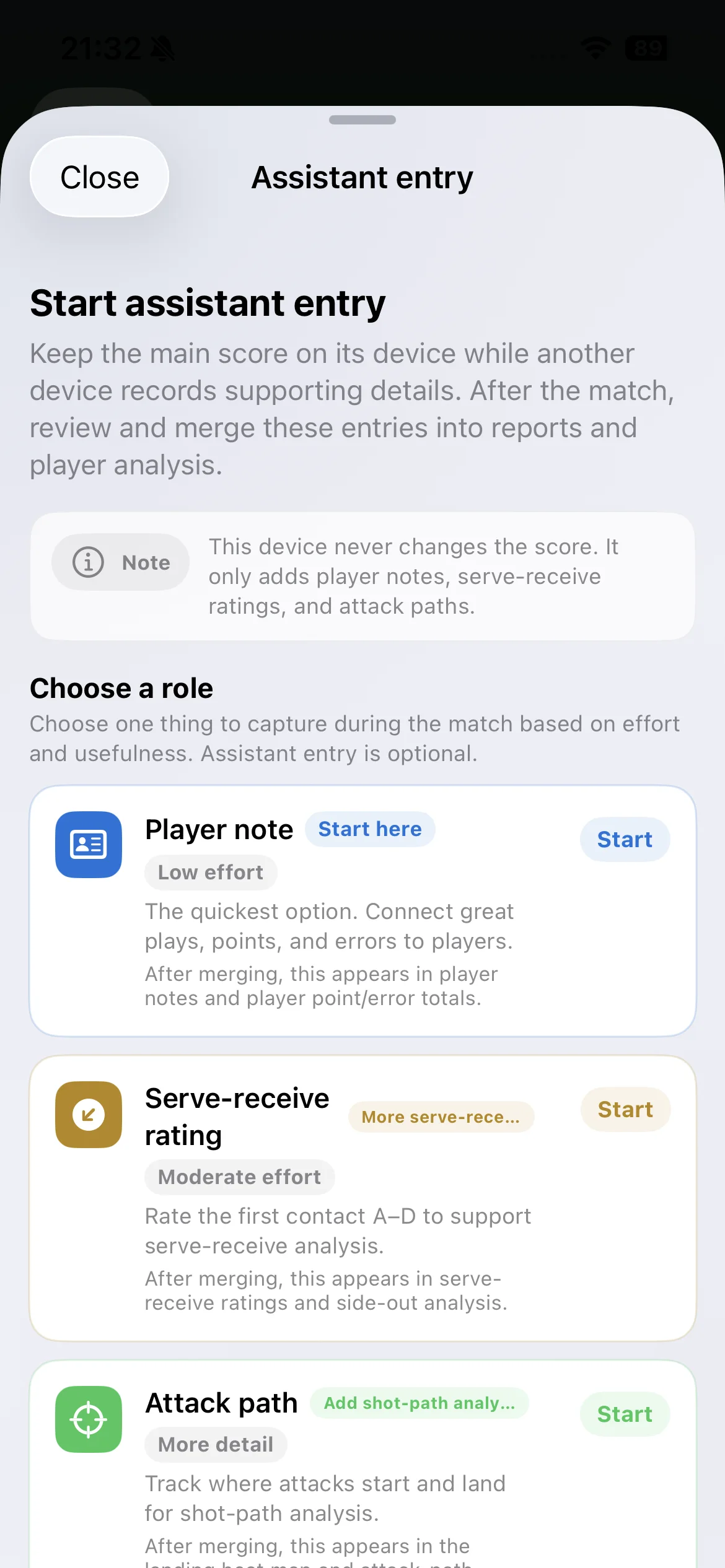
Shared analysis does not mean every person records the same thing. In fact, competing score sheets and duplicate notes make the review harder. A cleaner setup gives one person ownership of the main score while another staff member records a small amount of supporting input only when it will help after the match.
That supporting input might be a player note, a reception grade or a shot location. The main score does not change. After the match, the staff can review the extra observations with the result and decide whether they explain the team pattern. This keeps the bench focused while still allowing a manager or assistant coach to contribute meaningful detail.
Turn the report into one next practice priority
The final step is the one that makes analysis worth doing. Do not leave the review with five themes. Choose the issue that was clearest, name the evidence behind it and describe the situation the team needs to practice.
- Issue
- First-contact consistency was limiting the team's ability to side out under pressure.
- Evidence
- The match review showed a repeated side-out priority rather than a one-off error.
- Practice response
- Build a serve receive to first-attack drill that recreates the pressure the team saw.
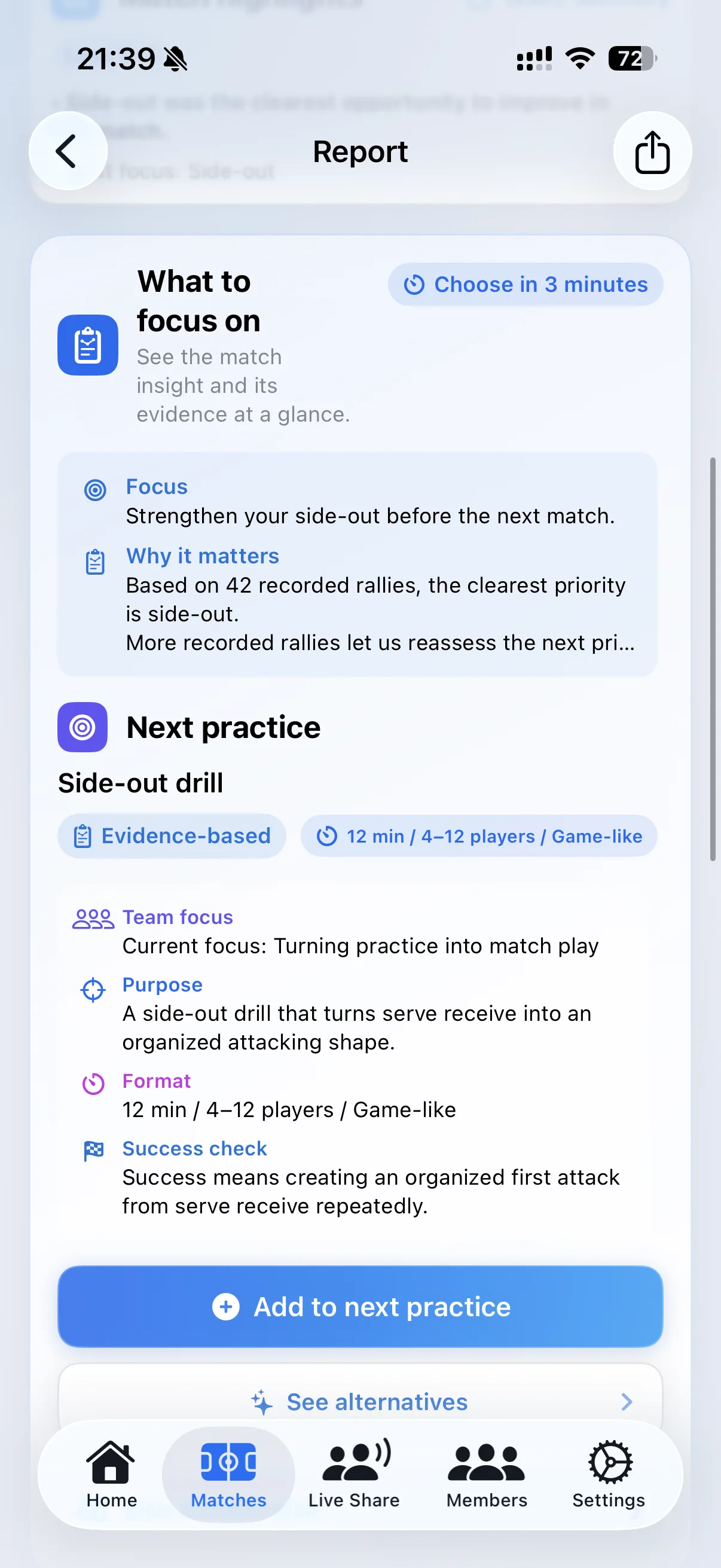
That brief is not a substitute for coaching judgment. It is a way to make the judgment visible, shareable and easier to revisit. After the next match, the team can ask whether the same problem appeared, whether the practice response helped and what should change next.
Use devices within the rules of your competition
Rules for phones and tablets on the bench vary by federation, competition and age group. Check the latest event regulations and the organizer's guidance before using any device during an official match. When bench use is not permitted, the same workflow can still support training matches, practice sessions and post-match review.
Volleyball match analysis questions
What should a coach analyze first?
Start with the team pattern that will change the next practice: serve receive and side-out context, a point-loss run or a rotation that repeatedly creates pressure.
Do we need to record every stat?
No. Record the smallest set of information that helps the staff make a better decision. Add player notes, reception grades or attack paths only when they will change the review.
Can staff share the work across devices?
Yes. One device can keep the main score while another staff member adds supporting observations. The staff can then review one report instead of separate notes.
Is there a free match analysis template?
Yes. The worksheet above is free, requires no account and works as a fillable PDF or a printed US Letter page. It is designed for team review rather than official scoring.
The goal is a better next conversation
A volleyball analysis app should not make a staff feel as though it needs to chase professional-level data after every set. For many teams, the strongest first system is the one that gets used: a clean score, a small amount of relevant context and a post-match discussion that ends with one decision.
Vollyze is built around that loop and is now available in English. This guide will continue to grow as coaches share the analysis questions that matter most in their own environments.
Use the next match to choose the next practice.
Download Vollyze in English, record one match and turn the clearest team pattern into a practical next focus.