2026 volleyball stats app comparison
Best volleyball stats apps for coaches: a practical 2026 comparison
From the Vollyze product team. This guide compares current official product information with the real English scoring, live review and reporting workflow available in Vollyze.
- Compare four current options without treating one workflow as right for every team.
- Decide which coaching question the app must answer.
- Test the input burden during a real set, not only at a desk.
- Use a free plan to test the full workflow, not only a demo screen.
- Check whether serve receive, rotations and scoring runs stay connected to the score.
- Make sure the report ends in an action the staff can take at practice.
Searching for the best volleyball stats app can make every product look similar. Most can record points. Many promise detailed analytics. The practical difference appears when a match is moving quickly: can the scorekeeper keep up, can the coach still watch the court, and can the staff understand the report without becoming a data department?
A good choice begins with your team workflow rather than a feature count. A club with a dedicated video analyst may need coded actions, video synchronization and a large scouting database. A school, youth or community team may get more value from a lighter volleyball stat tracker app that records the match, shows a repeated team issue and helps the coach decide what to practice next.
The short answer
Choose the smallest system that improves a real staff decision.
Judge an app by what happens from first serve to next practice. If the staff can record consistently, see the same team pattern and leave with one clear response, the data is doing useful work.
- On the bench Fast enough to keep watching.
- In the report Context stays connected.
- At practice One action is obvious.
Vollyze at a glance
A team-first volleyball stat tracker for iPhone
- Best fit
- Coaches and support staff at school, club, youth and community programs that want a practical team review.
- Match input
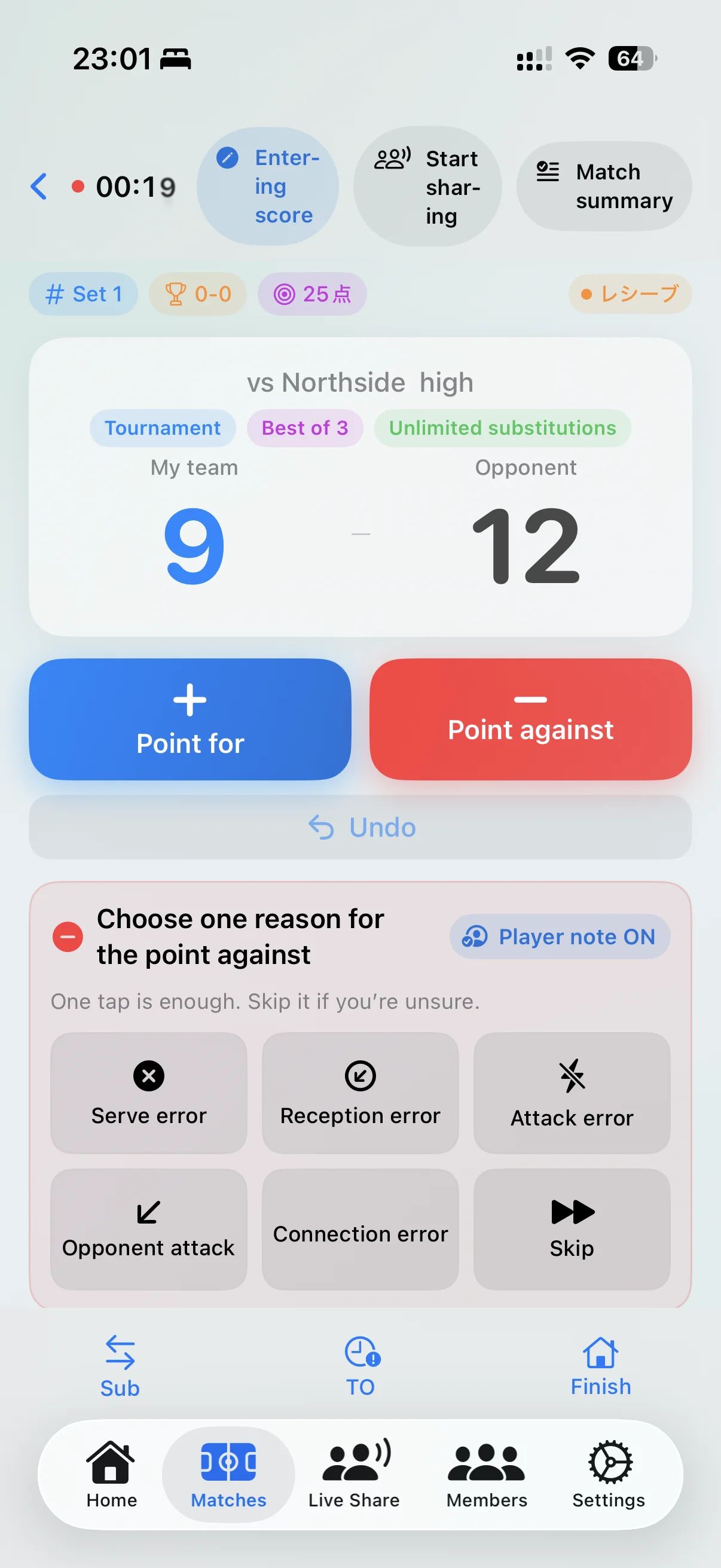
- Score first. Point reasons, player notes, A-D serve-receive ratings and attack paths stay optional.
- Live view
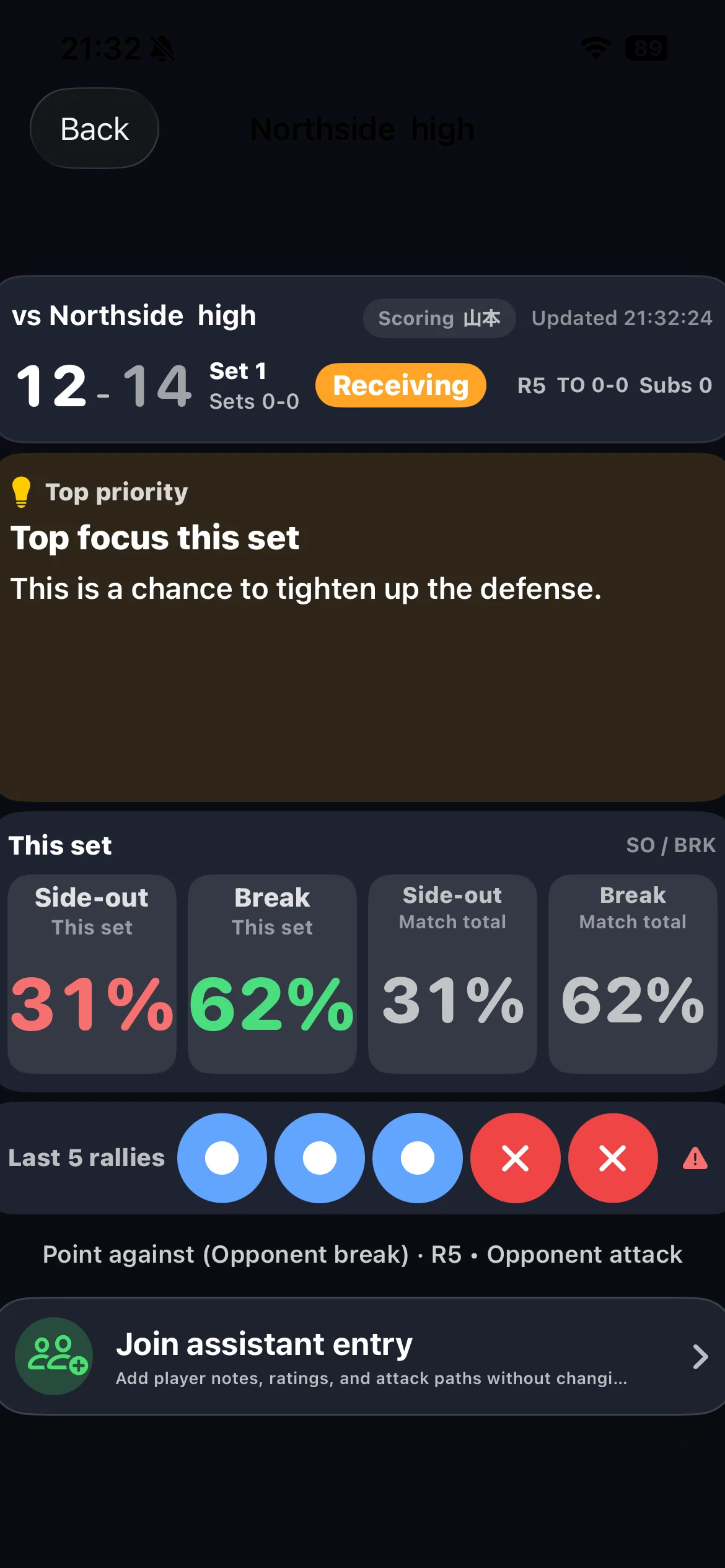
- Current score, last five rallies, side-out, break-point and rotation context.
- After the match
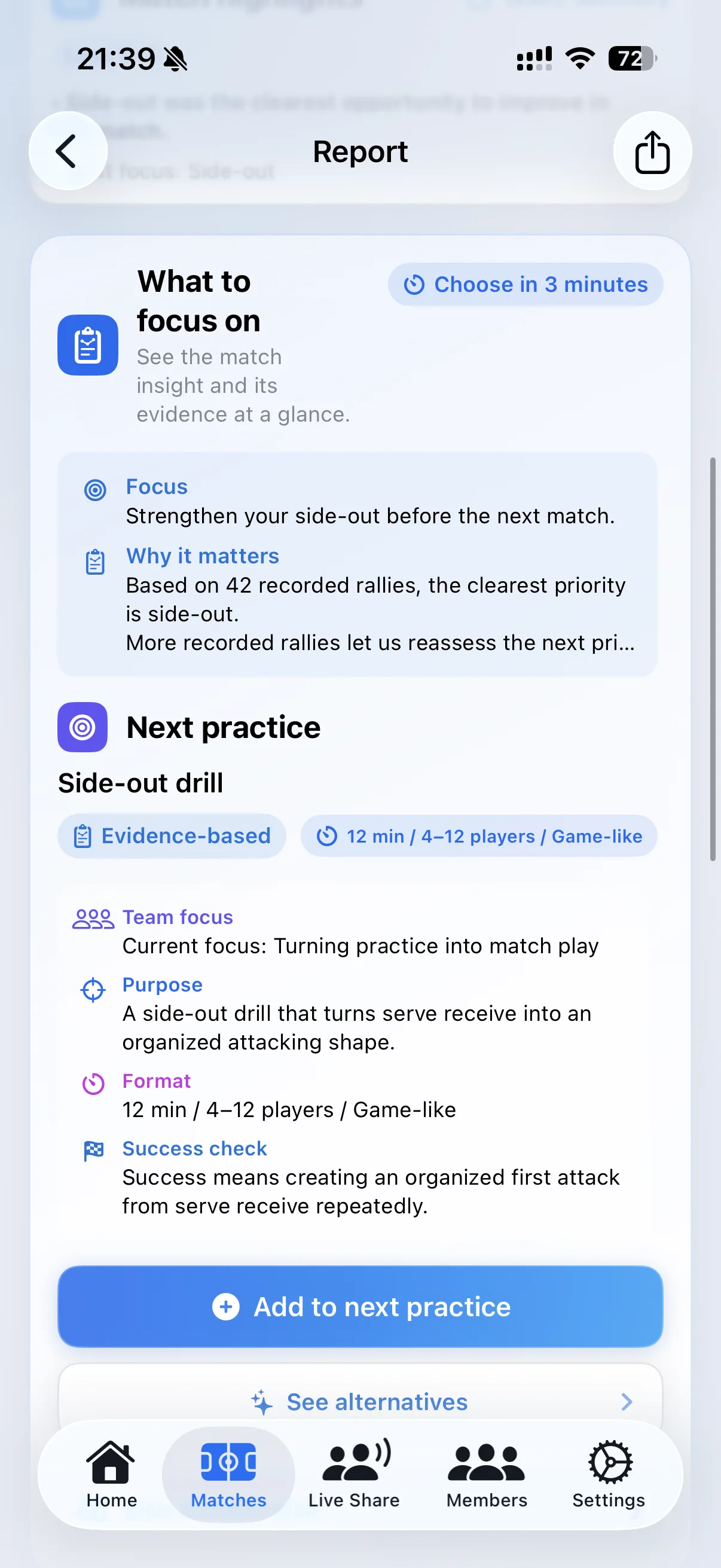
- Team and player reports, one evidence-based focus and a suggested next practice.
- Staff model
- One device owns the score; assistants can add selected detail without changing it.
- Starting point
- Free on iPhone for up to five recorded matches. Paid plans add analysis depth and sharing.
Choose another tool first if your main job is official scorekeeping, frame-by-frame video coding, professional opponent scouting or a custom data warehouse.
First, choose the right type of volleyball stats tool
“Volleyball stats app” can describe three very different products. Matching the tool to the staff capacity is more useful than comparing raw feature totals.
| Tool type | Best for | Typical recording load | Important limit |
|---|---|---|---|
| Score-only tracker | A clean score and set history | One tap per point | Usually does not explain why a run happened. |
| Team-first stats app | Coaches who want score, selected context and a practice response | Score first; optional detail when useful | Not a substitute for full video coding. |
| Video and scouting platform | Programs with analysts, coded video and opponent workflows | Dedicated staff time before or after the match | Can be more system than a small staff can sustain. |
Four volleyball stats apps compared by coaching workflow
There is no universal winner because these products solve different staffing problems. The comparison below uses each product's official website or App Store listing and focuses on the decision a coach must make before adopting a system.
Editorial disclosure: Vollyze publishes this guide and is included in the comparison. The list is not exhaustive and no placement was purchased. Product details were checked against official sources on July 17, 2026. Features, prices and platform support can change, so confirm them before choosing.
| Product | Best fit | Input and analysis model | Starting model |
|---|---|---|---|
| Vollyze | School, club and community coaching staff who want one team issue to become the next practice focus. | Score-first iPhone workflow with optional point reasons, player notes, A-D reception ratings and attack paths. Live side-out, break-point and rotation context leads into team reports and practice planning. | Free for up to five recorded matches. Monthly and annual Pro, Staff and Team plans add depth and shared use. |
| SoloStats123 | Coaches who want conventional player and skill stat capture, offline use and an export-oriented ecosystem. | A select-player, select-action, confirm flow on iPhone and iPad. It records major volleyball stats and connects to SoloStats reporting products. | Unlimited stat capture is advertised as free. Paid bundles add cloud sync, exports, multi-device support and deeper WebReports analysis. |
| iStatVball 3 | Programs that want detailed ball-contact data, opponent tendencies, shot charts, heat maps, video sync and season analysis. | RallyFlow court-based entry or its legacy interface on iPhone and iPad, with adjustable detail and real-time reports. | A 14-day full trial. The official purchase page lists one Team-Season at US$39.99 with no auto-renewing subscription. |
| Stat Together | Teams that want several managers to enter different stats at the same time and share results with fans. | Connected iOS and Android devices combine simultaneous stat entry, shot and serving charts, MaxPreps or Excel export and a team website. | Free download with in-app purchases. The current U.S. App Store listing shows trial and season-access purchase options. |
Official sources: SoloStats123 product page, iStatVball 3 product page, iStatVball purchase page, Stat Together product page and the Stat Together U.S. App Store listing.
What the comparison means in practice
- Choose Vollyze when the main gap is turning a manageable match record into one shared practice decision.
- Choose SoloStats123 when familiar skill totals, offline capture and school-platform exports are central to the job.
- Choose iStatVball 3 when the staff can sustain deeper contact-level recording and will use advanced charts, opponent analysis or video.
- Choose Stat Together when several available statisticians can divide live entry and fan-facing sharing matters.
Whichever product looks closest, run one practice match before committing the staff. The best feature list cannot compensate for an input model the team cannot sustain.
What should a free volleyball stats app let you test?
A free plan is useful when it lets the staff complete a real match workflow: set the lineup, record the score, review a team pattern and decide what to do next. A limited trial that reveals only the input screen does not show whether the report is understandable or whether the app will survive a full set.
- Record enough complete matches to judge speed, correction and reliability.
- See at least one useful report before entering payment details.
- Understand which analysis, history and sharing features require an upgrade.
- Know the monthly and annual price before building the tool into staff routines.
| Plan | Current U.S. price | Best for | What changes |
|---|---|---|---|
| Free | US$0 | Testing the complete workflow with one team | Record up to five matches and see the clearest next-practice priority. |
| Pro | US$5.99 monthly US$49.99 yearly | An individual coach who wants more review depth | Adds comparisons, monthly review and deeper practice planning. |
| Staff | US$14.99 monthly US$119.99 yearly | A coach, assistant and manager | Shares the workflow with up to three staff members. |
| Team | US$29.99 monthly US$249.99 yearly | A larger adult coaching staff | Expands shared use to as many as 30 adult staff members. |
Price transparency: these are the current U.S. prices shown by Vollyze. The price, billing period, taxes and local availability shown at App Store checkout apply.
1. What decision should the app improve?
Start by naming the moment in which the app must help. Is it a timeout conversation, a post-match staff review, an individual player meeting, opponent scouting or planning the next practice? These are different jobs. An app can be excellent at one and unnecessarily heavy for another.
For a team-first review, useful questions might be: Where did the longest run of points against us begin? Did first contact give us a playable attack? Which rotation repeatedly faced the same pressure? What situation should we recreate at the next practice? A feature matters only when it helps answer one of those questions.
2. Can someone record a full set without losing the match?
Input burden is the most important test and the easiest one to miss. A demo can feel simple when the score is not moving. During a match, the recorder also needs to follow substitutions, listen to the bench and recover from a missed rally.
- Can the main score be recorded with one clear action per point?
- Can optional details be skipped without breaking the report?
- Can a missed rally be corrected or completed later?
- Are buttons readable and usable from a normal bench position?
Test the app in a practice match before building a team routine around it. If the recorder regularly falls behind, reduce the data you collect or separate the responsibilities.
3. Does it connect the stats that explain the rally?
A final score tells you what happened, but not why the same pressure kept returning. A practical volleyball analysis app should preserve enough context to connect the score with the phase of play.
| Signal | Question it should answer | What to avoid |
|---|---|---|
| Score flow | When did control of the set change? | Looking only at the final score. |
| Serve receive | Did first contact keep the intended attack available? | Treating an A/B/C grade as the whole story. |
| Side-out / break | How often did we win rallies while receiving or serving? | Comparing percentages with different denominators. |
| Rotation | In which lineup context did the pressure repeat? | Blaming a rotation without reviewing what happened in it. |
| Point-loss reason | Which basic problem appeared in the run? | Adding so many categories that recording stops. |
4. Does it match the level of analysis your team can use?
Professional and national-level programs can benefit from detailed individual coding, video tagging and opponent scouting because they have people and time assigned to those tasks. That does not make the same workload necessary for every team.
Many teams can begin with the team pattern: first-contact stability, side-out context, scoring runs and rotation pressure. Individual analysis can then be added when it explains that pattern. A player note, reception grade or attack location is valuable when it gives the team a more precise practice response. It should not become a demand to rate every player on every rally.
5. Can the staff divide the work without creating competing records?
Shared access is useful only when responsibilities remain clear. One device should own the score. A second person can add supporting details without changing it. After the match, the staff should see one merged view rather than separate notes that must be reconciled manually.
Ask what each role can do, how invitations work, what happens when connectivity is weak and whether the data remains understandable when the original recorder is not present.
6. Does the report show evidence before a recommendation?
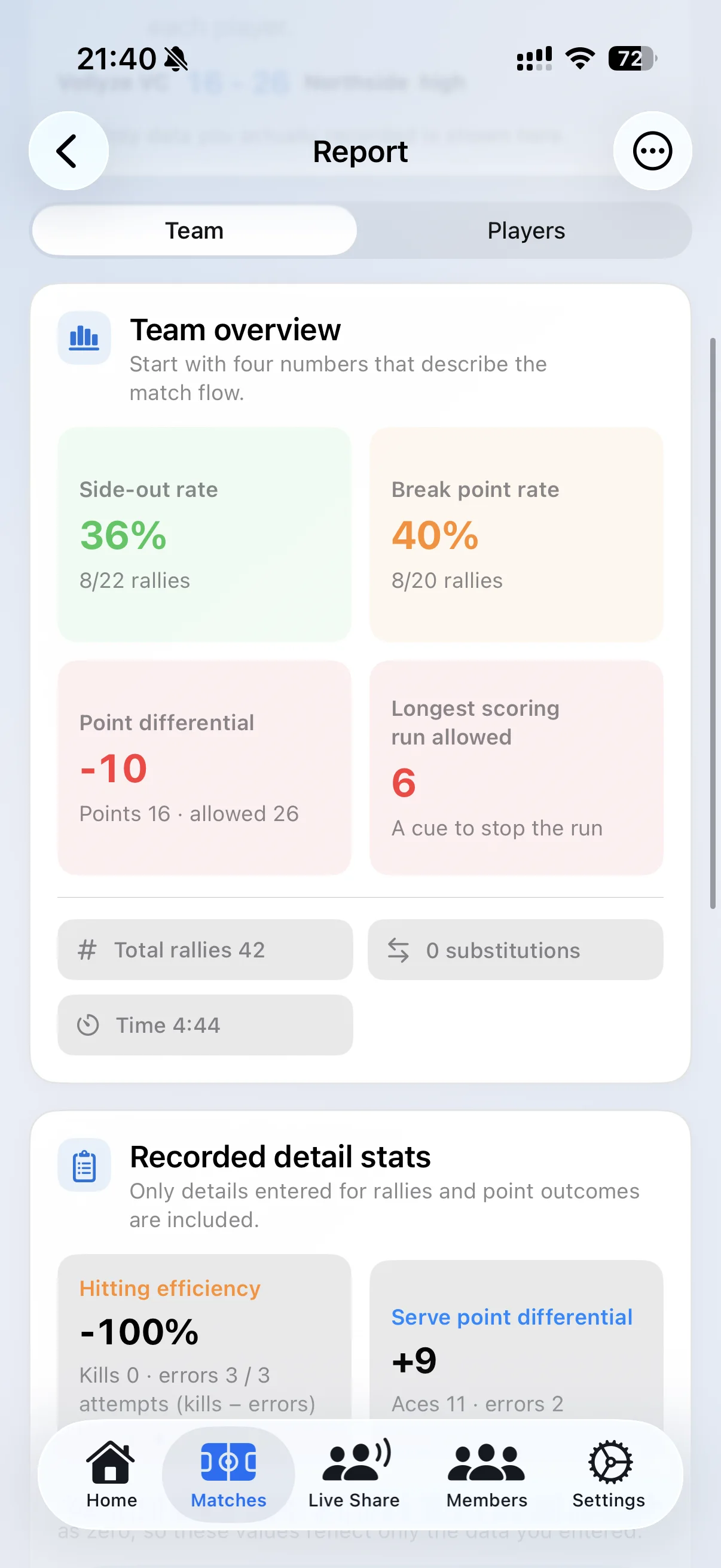
A recommendation is easier to trust when the coach can inspect the evidence behind it. The report should keep the sample, the score flow and the relevant phase of play close to the suggested priority. It should also make uncertainty visible when too little detail was recorded.
7. Can the staff turn the report into the next practice?
The final test is whether the app changes what happens next. A useful report should help the staff write a short decision brief: the issue, the evidence and the situation to train. The app does not replace coaching judgment. It should shorten the distance between observing a pattern and designing a response.
- Issue
- Side-out became unstable after difficult first contact.
- Evidence
- The same pressure appeared in a scoring run and one rotation context.
- Practice response
- Recreate that serve-receive pressure and connect it to the first attack.
Where Vollyze fits, and where it does not
Vollyze is designed for coaches and staff who want a team-first path from live scoring to the next practice. It emphasizes a manageable scorekeeping workflow, serve-receive and rotation context, shared staff input, match reports and practice planning. Individual notes and ratings can add detail without making every rally an individual coding task.
If your primary need is frame-by-frame video coding, professional opponent scouting or a custom data warehouse, a dedicated video-analysis platform may be a better starting point. If the problem is that useful match observations never become a shared practice decision, Vollyze is built for that gap.
Frequently asked questions
Which volleyball stats app is best for coaches?
The best choice depends on the staff workflow. Vollyze fits teams that want a score-first path from live context to the next practice. SoloStats123 emphasizes conventional stat capture and exports, iStatVball 3 emphasizes deep ball-contact and season analysis, and Stat Together emphasizes simultaneous entry by multiple statisticians.
What should a volleyball stats app record first?
Start with the score and the smallest amount of rally context that changes a coaching decision. Add optional detail only when the staff will use it.
Is a volleyball stat tracker useful for youth or school teams?
Yes, when input stays light and the review leads to a clear action. Check the rules of the competition before using a device during an official match.
Does every team need professional-level analytics?
No. Many teams benefit first from reliable team patterns and a repeatable review process. Add depth as staff capacity and coaching questions grow.
Can more than one staff member contribute?
Yes, when one person owns the score and other roles add clearly separated supporting details.
Is there a free version of Vollyze?
Yes. The Free plan lets a coach record up to five matches and evaluate the core match-to-practice workflow before choosing a paid plan.
See whether Vollyze fits your staff.
Download Vollyze in English and test the complete match-to-practice workflow with one real match.