Free coaching template + match-to-practice guide
Free volleyball practice plan template: from match evidence to one clear session
From the Vollyze product team. This guide uses real English screens from the match report, practice recommendation and shared team workflow now available on the App Store.
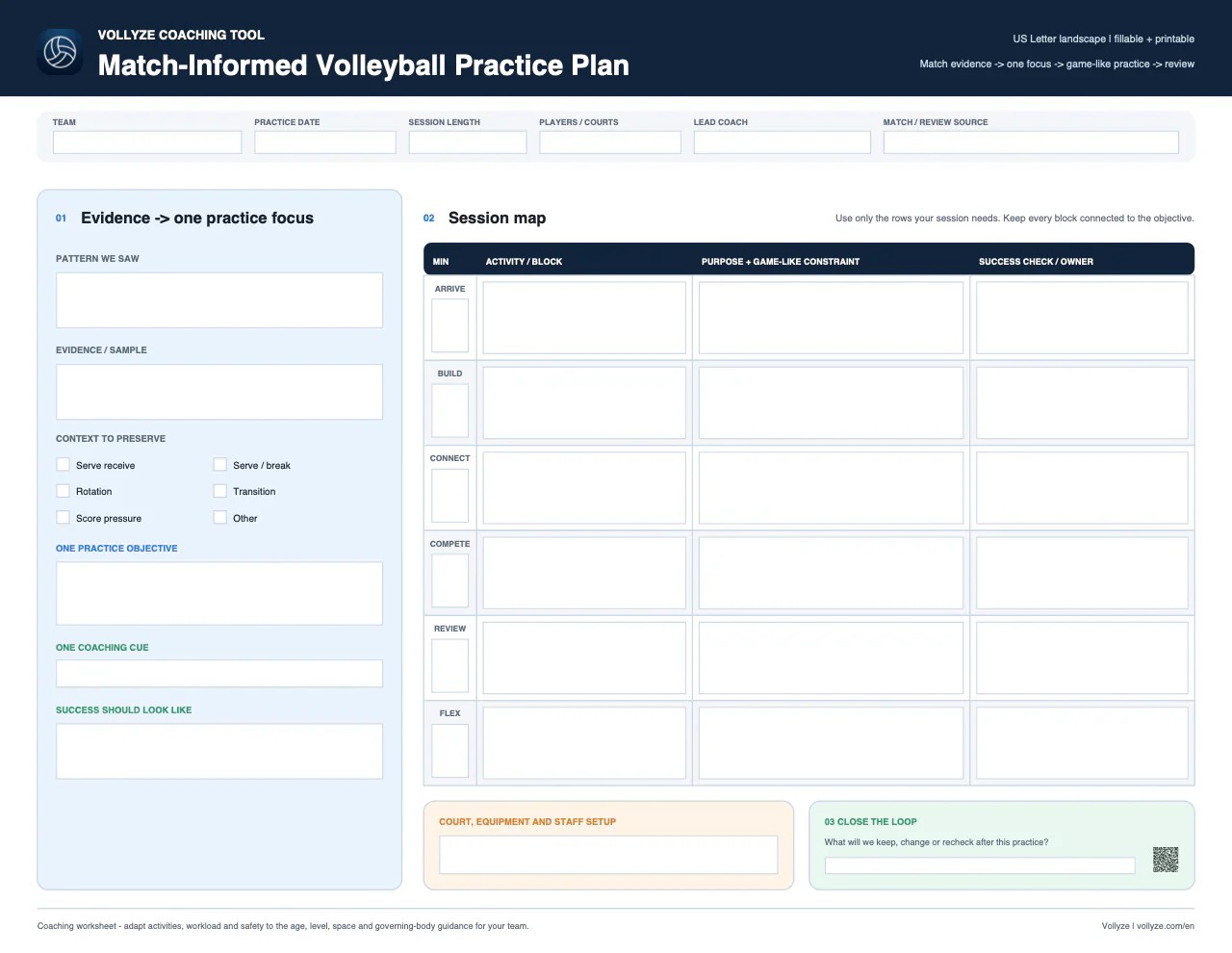
Free fillable PDF
Download the volleyball practice plan template
Choose A4 or US Letter. Type into the fields in a compatible PDF viewer, or print the one-page landscape sheet and write by hand. No email or account is required.
- Match pattern, evidence and one practice objective
- Six flexible session blocks with minutes and ownership
- Game-like constraints, coaching cue and success check
- Staff setup and a short post-practice review
1 page | fillable fields | free coaching use
- One team problem that is specific enough to train.
- Evidence that the problem repeated rather than appearing once.
- A game-like activity that recreates the same decision.
- A success check the staff and players can understand.
- One shared plan that can be reviewed after practice.
A volleyball practice plan template can solve several different jobs. Some coaches need a blank schedule. Others want a drill library or a timed session builder. The free sheet above focuses on a gap that ordinary time blocks often leave unanswered: why this team needs this practice today. Vollyze applies the same match-to-practice logic inside the app.
The distinction matters because a list of drills does not explain which drill the team needs today. Match statistics do not solve that problem by themselves either. The coach still needs to identify a repeated situation, choose a response that fits the team and decide how success will be observed.
The short answer
Plan the response, not only the schedule.
Use the last match to choose one trainable situation. Then define the purpose, game-like constraint, format and success check before selecting the drill.
- Evidence What repeated?
- Response What will practice recreate?
- Check What will improvement look like?
What kind of practice planning does your staff need?
Before choosing an app, separate the planning job from the features around it. A product can be excellent at scheduling without connecting to match analysis. Another can recommend a training focus without managing an entire season calendar.
| Planning job | Useful when | Question to ask |
|---|---|---|
| Calendar and attendance | The club needs dates, locations and player availability in one place. | Can families and staff see schedule changes? |
| Drill library | The coach needs activity ideas for a skill or age group. | Can each drill be adapted to the players and space available? |
| Session builder | The staff needs a timed order, equipment list and role assignments. | Can assistants understand the plan without another meeting? |
| Match-to-practice planner | The team needs to turn a match pattern into the next training priority. | Does the plan show the evidence and a success check? |
Vollyze is primarily a match-to-practice planner. It can store the selected next practice and share the same team focus with staff, but it is not presented as a full club calendar or an unlimited generic drill marketplace.
Begin with the smallest useful body of match evidence
A practice theme should not be selected because one rally was memorable. Start with the score flow and team overview, then inspect the phase that produced the pressure. Side-out, break-point rate, rotation context, first-contact quality, point-loss reasons and staff notes can all help, but only when they answer the same coaching question.
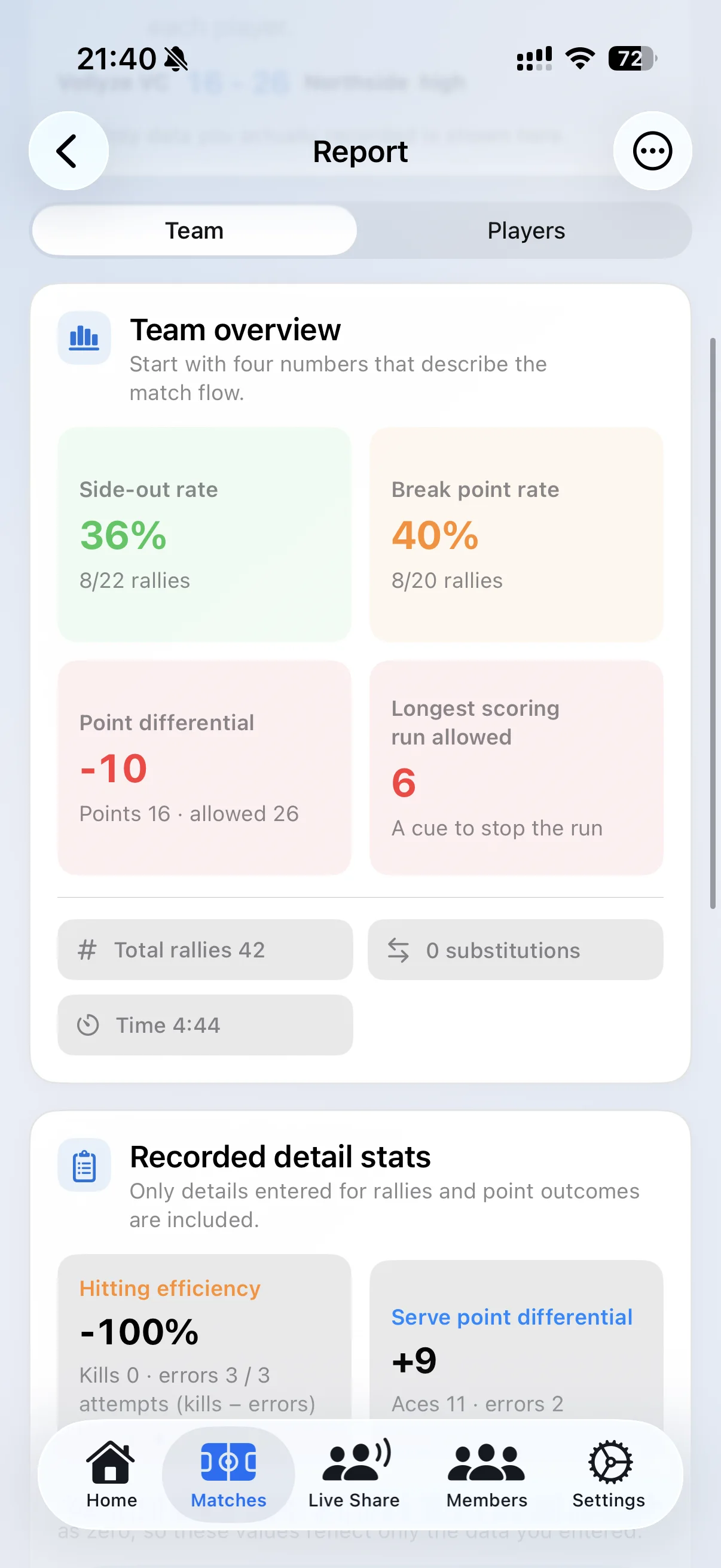
Use sample size honestly. A set can reveal a coaching question, but it may not prove a stable trend. Compare the observation with recent matches and what the staff saw on court before changing a longer-term plan.
Write a decision brief before choosing the drill
A short decision brief prevents the staff from jumping from a percentage to a generic activity. It should name the situation, the evidence and the response the team needs to rehearse.
- Issue
- Side-out became unstable when the opponent served the seam in Rotation 4.
- Evidence
- The longest run against started there, and the intended first attack was unavailable on several recorded rallies.
- Practice response
- Recreate the seam serve, clarify first-ball responsibility and connect the reception to two attack options.
The brief is deliberately narrow. “Improve serve receive” is too broad to design a useful session. “Resolve seam responsibility and preserve two first-attack options in R4” gives the players a situation they can recognize.
How to use the printable practice planner
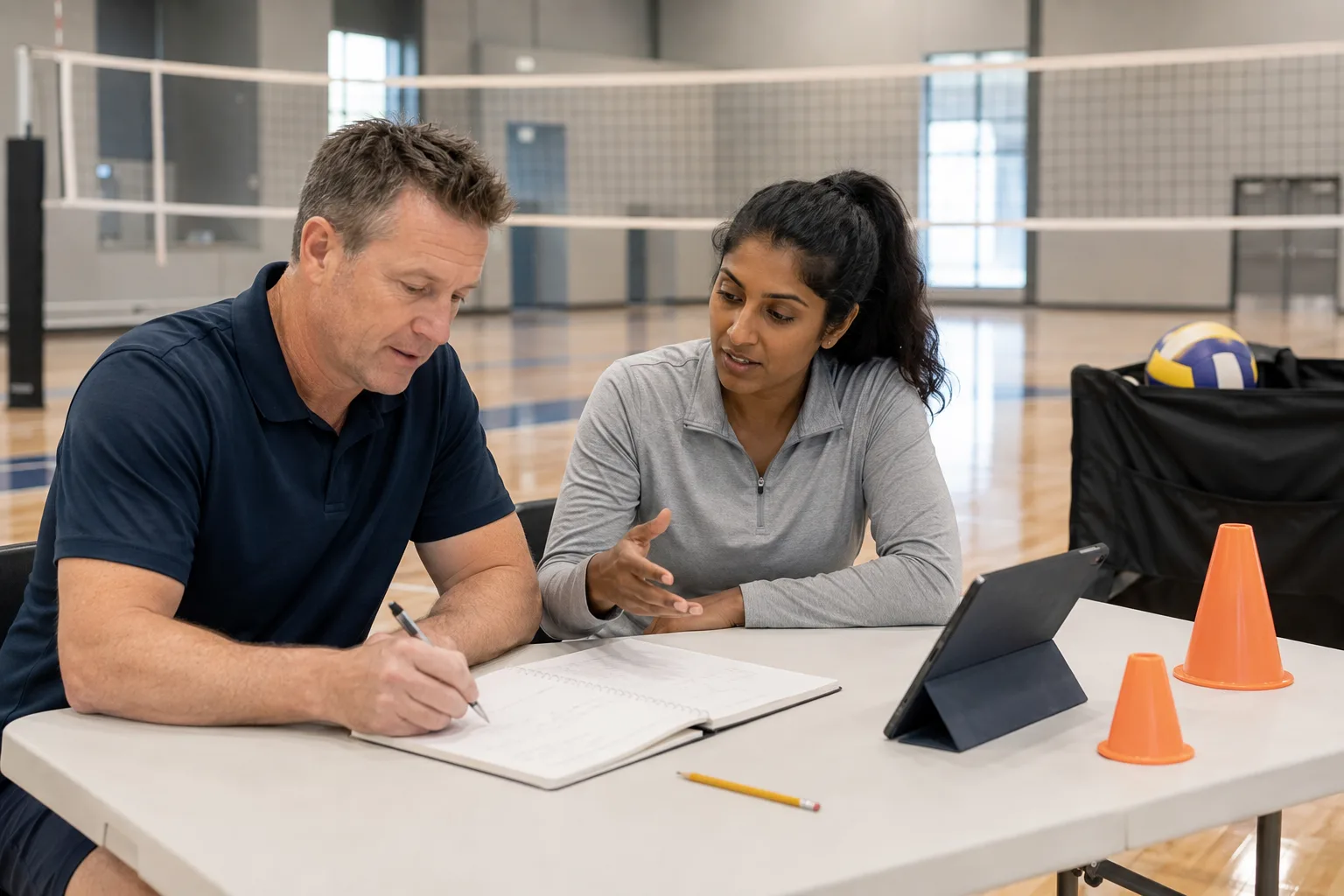
- Name the repeated match pattern. Write what happened, where it happened and the rally sample or staff observation behind it.
- Choose one objective. Describe the team response you want to improve, not a list of unrelated skills.
- Map only the blocks you need. Use the six rows for arrival, skill building, connected play, competition, review or any sequence that fits the available gym time.
- Preserve the decision. Add the serve, rotation, transition, score pressure or other constraint that made the match situation real.
- Define success and ownership. Record what staff will observe and who will manage each block.
- Close the loop. After practice, note what to keep, change or recheck in the next match.
Build a game-like response with a visible success check
The activity should preserve the decisions that made the match situation difficult. If the issue involved serve pressure, receiver responsibility and the first attack, a line of isolated passing repetitions may remove the exact problem the team needs to solve.
USA Volleyball's official lesson-plan resources emphasize game-like work, skill combinations, time and player-tracked outcomes. The FIVB also publishes coaching manuals and education resources. Use those materials and your governing body's coach education to adapt any suggested activity to the age and level of your athletes.
For a practical session plan, write down:
- Purpose. Name the match situation the activity is meant to improve.
- Format. Set the players, court space, time, scoring and rotation context.
- Constraint. Preserve the serve, first contact or decision that created the original pressure.
- Coaching point. Choose one cue that helps the team solve the situation.
- Success check. Define an observable outcome, not only “looked better.”
- Progression. Decide how to increase or reduce difficulty without losing the purpose.
Compare alternatives without losing the original problem
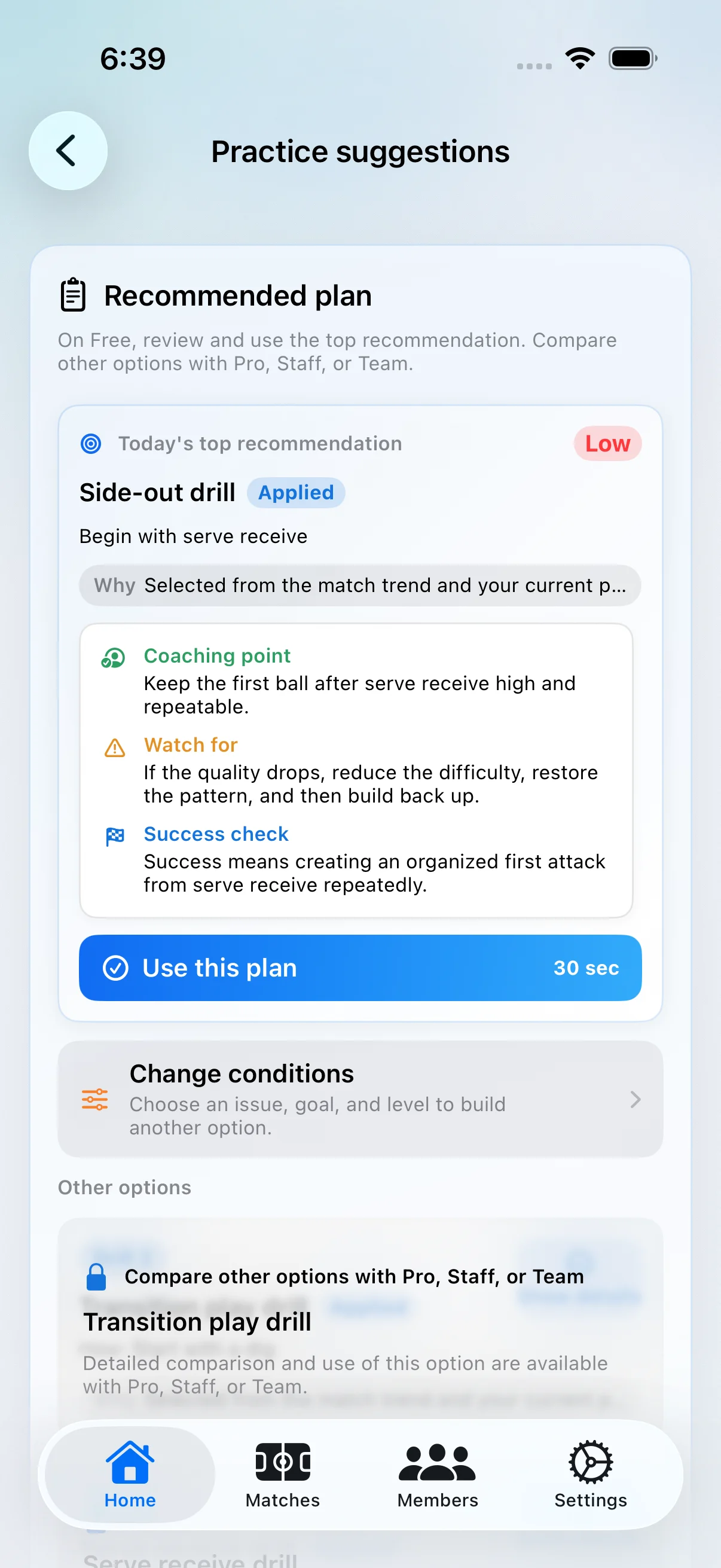
There may be several reasonable ways to train the same issue. One team may need a controlled first-contact progression. Another may be ready for a scored six-on-six wash drill. A useful planner should allow alternatives while keeping the evidence and intended response visible.
In Vollyze, the staff can review a recommended plan, inspect alternatives and change conditions such as the issue, goal and level. The recommendation is a starting point for coaching judgment, not an instruction the app can verify from the sideline.
Give the staff one shared next action
A plan becomes more useful when the head coach, assistant coach and manager see the same objective. Assign who introduces the activity, who manages balls or scoring and who watches the success check. This is more actionable than sharing a long report with no ownership.
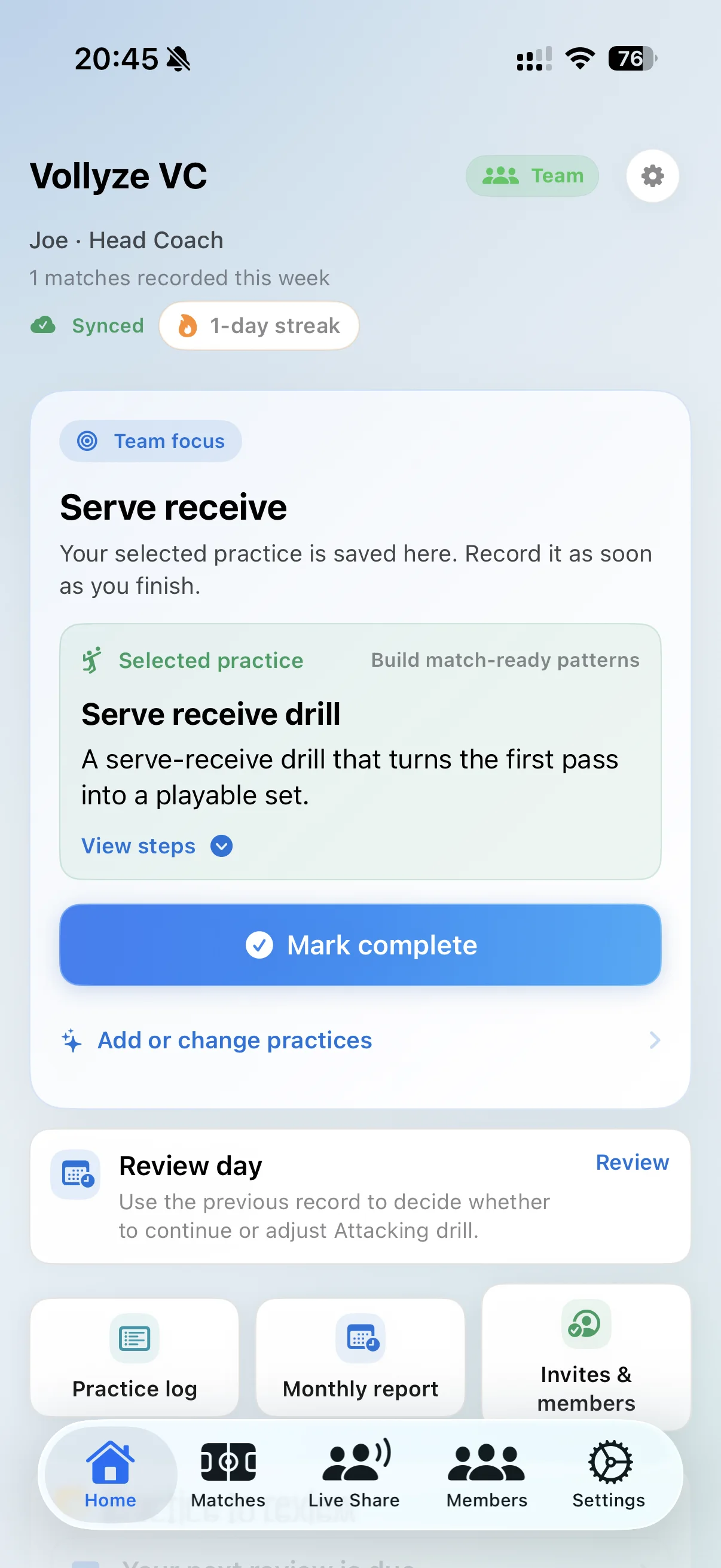
After practice, record whether the team completed the plan and what should be repeated or adjusted. The next match then becomes another observation point: did the same pressure return, did the response improve and is the original priority still the right one?
Who this workflow fits
This approach fits school, club, youth and community teams that already review matches but struggle to turn observations into one shared practice decision. It is also useful for coaching teams that do not have a full-time analyst and need a record they can maintain during a normal week.
If the main requirement is season scheduling, attendance, facility booking or a large standalone drill marketplace, evaluate a specialist planning product for those jobs. Vollyze is designed for the shorter loop from match evidence to the next team focus.
Frequently asked questions
What should a volleyball practice planner include?
Include one objective, its evidence, a game-like activity, the format, a success check and clear staff ownership.
Should every match problem become a practice theme?
No. Choose the pattern that repeated, matters to the next competition and can be trained safely in the time available.
Is a drill library the same as a practice planner?
No. A library helps find activities. A planner connects an activity to a purpose, sequence, constraint and success check.
Can I type into the practice plan PDF?
Yes. Both downloads include fillable fields. You can also print the one-page landscape sheet and write by hand.
Can Vollyze create a plan from match data?
Vollyze connects recorded patterns with a recommended focus and alternatives. The coach reviews and adapts the plan to the team's context.
Make the next practice answer the last match.
Download Vollyze in English, record one match and choose one evidence-based plan your staff can use next.