Choosing a coaching tool
A volleyball coaching app for high school and club teams should connect match day to practice
From the Vollyze product team. This guide uses real English screens from the scoring, live review, staff input and practice workflow available on the App Store.
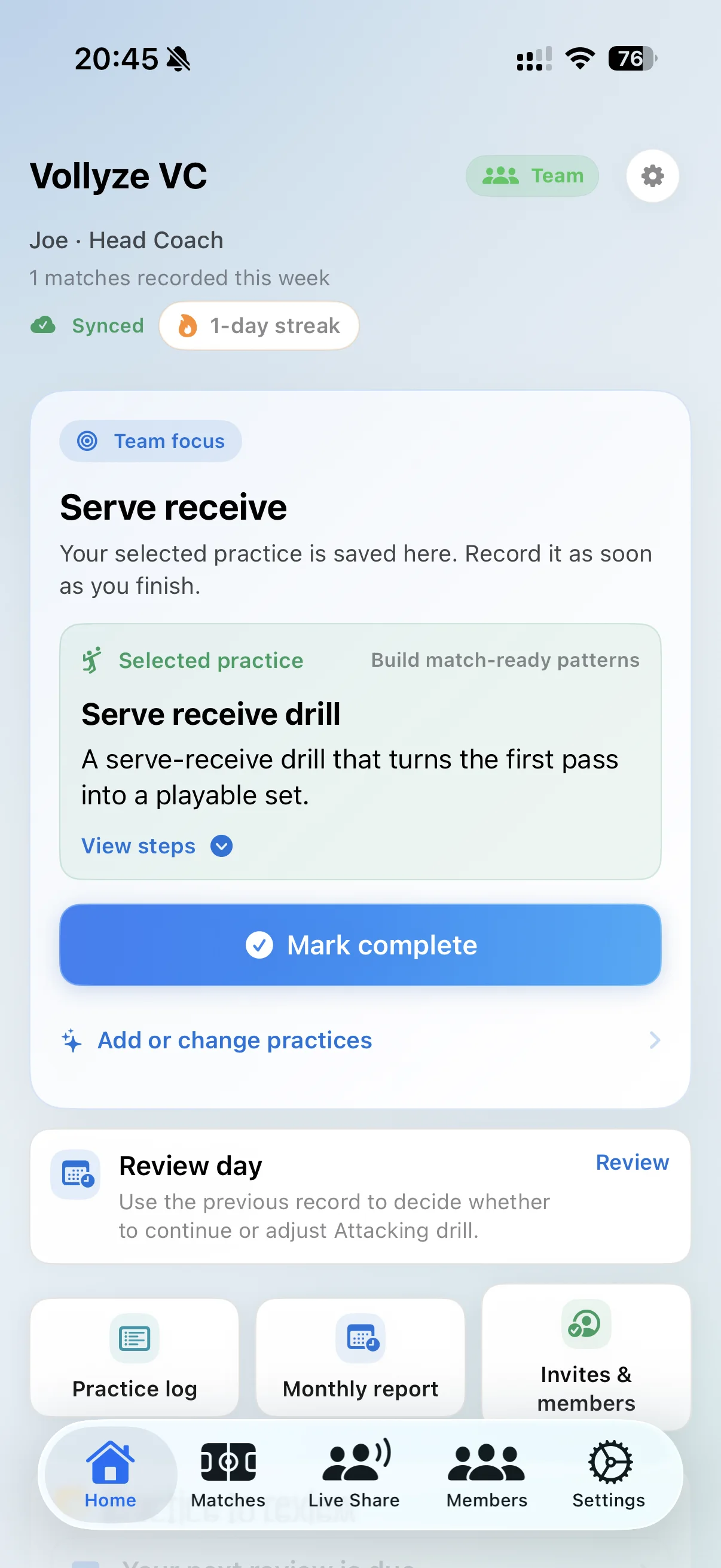
- Record the match without making the staff stop watching it.
- Review a team pattern with enough context to act on it.
- Share one decision and revisit it at the next practice or match.
The phrase volleyball coaching app can describe very different tools. One app teaches rotations. Another stores drills. Another records every contact for a complete box score. A team-management platform may handle schedules and messages without analyzing a single rally.
None of those categories is automatically better. The useful question is whether the app solves the job your staff repeatedly struggles to finish. For many high school, club, youth and community teams, that job is not collecting more numbers. It is keeping a reliable match record, identifying one team problem and turning it into a shared practice response.
The short answer
Choose the workflow before you choose the app.
Write down the decision your staff should make after using the tool. Then test whether the input, report and sharing model make that decision easier.
- Match day What can we record reliably?
- Review What pattern can we explain?
- Practice What will we change next?
Four common types of volleyball coaching app
Many products combine categories, but identifying the main job helps a coach compare them fairly.
| App type | Best at | Question to ask before choosing |
|---|---|---|
| Rotation or lineup planner | Teaching positions, serve-receive formations and transitions. | Do we need to teach where players go, or analyze what happened there? |
| Stats and scorekeeping app | Recording rallies, player actions and match totals. | Can our available recorder keep up during a real set? |
| Practice planner or drill library | Building timed sessions and finding activities. | Does the plan respond to the last match, or start from a generic library? |
| Team workflow app | Keeping staff roles, match review and the next action together. | Will the same information reach the people who need to coach it? |
Vollyze sits between the second, third and fourth categories. It keeps a light match record, shows team-level context and carries one priority into practice. It is not a rotation animation tool, an official electronic scoresheet or a professional video-coding system.
What different teams should prioritize
A repeatable match-to-practice loop for a school or club season
A high school or club volleyball app should still be usable when the schedule becomes crowded. The strongest test is not whether the first demo looks impressive. It is whether the staff can repeat the same short loop after a weekday match, a weekend tournament and the next practice.
| Moment | Minimum useful record | Staff decision |
|---|---|---|
| Before the match | Confirm the roster, starting lineup, libero and match format. | Who owns the score, and which optional detail is worth recording? |
| During the match | Keep the score, service phase, rotation and selected point reasons connected. | What is the one question to check at the next timeout? |
| After the match | Review score flow, side-out, break point, scoring runs and relevant observations. | Which repeated team issue deserves the next practice? |
| At the next practice | Keep the chosen focus, activity and success check visible. | Did the response improve the same situation when it returned? |
This rhythm matters more than collecting every statistic. A smaller record that the staff completes and revisits can be more useful than a detailed system that disappears after tournament weekend.
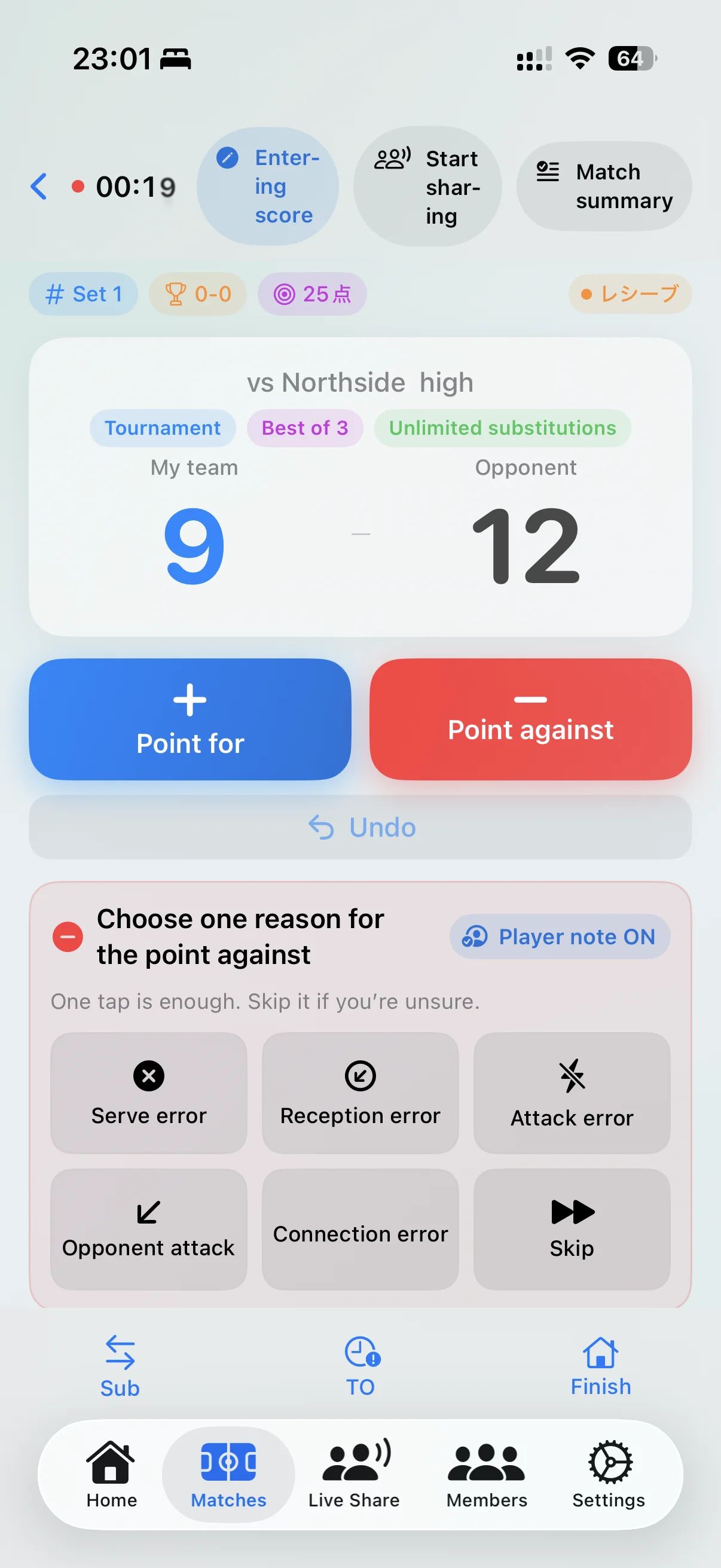
1. Protect the match-day experience
A coaching app should not take the coach out of the match. Test the input during a real set. The main score actions should remain obvious, correction should be quick and extra detail should be optional. If the recorder has to navigate several screens before the next serve, the workflow will fail when the match becomes stressful.
2. Keep the team pattern connected to the score
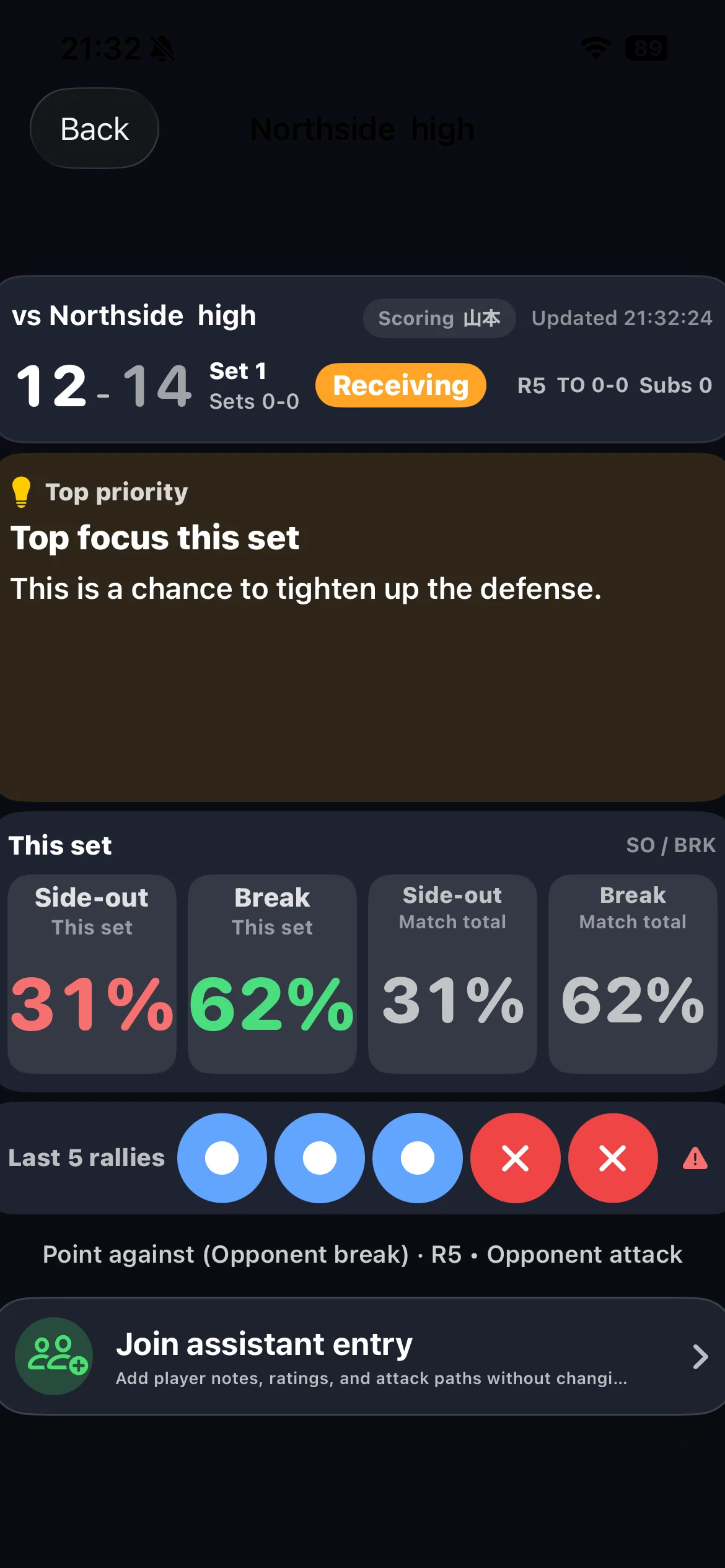
A final score says who won. It does not show whether the team struggled to side out, allowed one damaging scoring run or repeatedly lost the same rotation context. A useful report keeps those signals near the match flow and their denominators.
Do not treat a percentage as a verdict. Side-out, break-point rate, reception grades and rotation results are places to investigate. The staff still needs to review the serve pressure, first contact, available attack and sample size behind the number.
3. Give each staff member one clear role
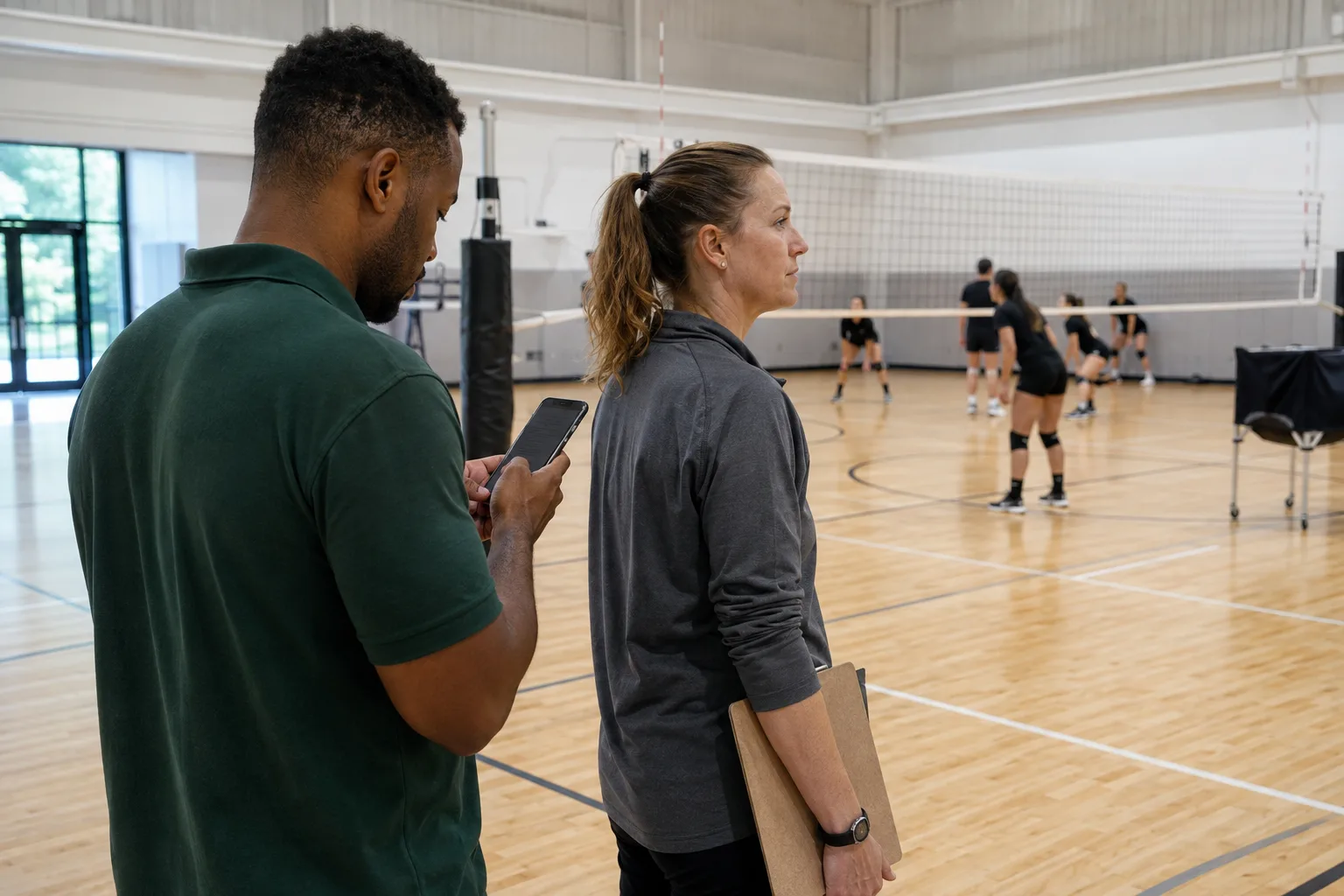
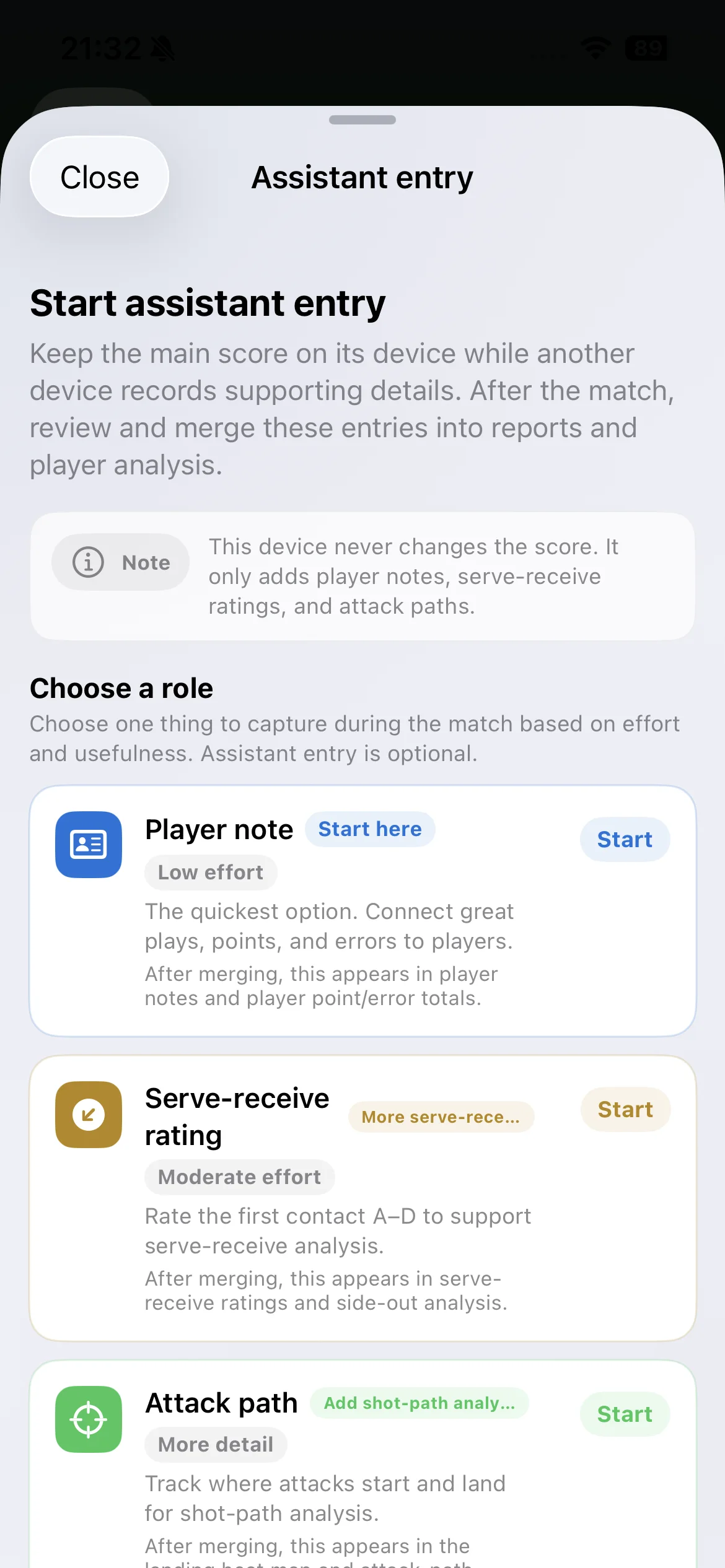
Shared input is useful only when everyone knows who owns the authoritative score. One person can keep the main match record while another adds a player note, serve-receive rating or attack path without changing the score. This separation reduces duplicate records and gives the second person a narrow task that can be done well.
4. Require the report to change the next practice
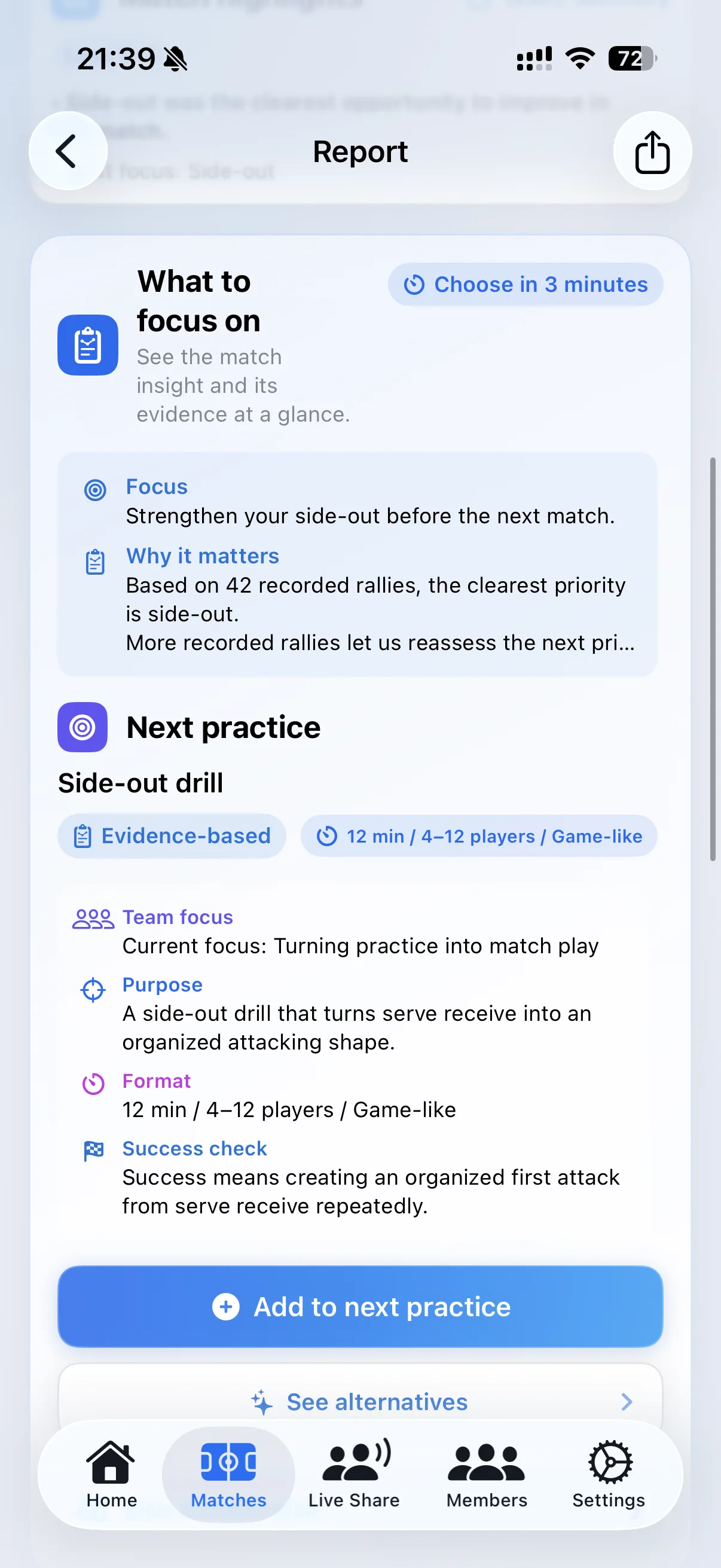
A dashboard can be visually impressive and still leave the staff asking, "What do we do with this?" The review should end with a short decision brief: the issue, the evidence and the practice response. That response should recreate the pressure that made the match situation difficult.
- Issue
- Side-out became unstable when first contact limited the intended attack.
- Evidence
- The same receiving pressure appeared in the scoring run and one rotation context.
- Practice response
- Recreate the serve target, receiving responsibility and first available attack.
A 10-minute test before your staff commits
- Create one sample team. Check how long it takes to add the players and starting lineup you actually use.
- Record ten fast rallies. Include an undo, a missed detail and a rotation change. Notice where the recorder stops watching the court.
- Ask an assistant to contribute. Confirm that roles and permissions are understandable without a long explanation.
- Open the report without a tutorial. Ask the coach to identify the first team question worth discussing.
- Choose the next practice focus. If the app cannot move from evidence to action, decide whether that gap matters to your staff.
- Check the return path. Make sure the decision is still visible when the next practice or match begins.
Use the Free plan to test the workflow, not only the interface
Vollyze Free supports up to five recorded matches on iPhone. Use those matches as an evaluation period: one simple score-only test, one match with selected point reasons, one timeout review, one full post-match report and one return check at the next practice.
The goal is to learn whether the process survives real staffing, noise and time pressure. Upgrade only when the five-match limit, deeper reporting or shared access becomes the constraint. The Free volleyball stats app guide provides a match-by-match evaluation plan.
Where Vollyze fits, and where it does not
Vollyze is designed for coaching teams that want a practical path from live scoring and selected observations to one team-level practice decision. It supports individual player notes and reception ratings, but it does not require every rally to become an individual evaluation.
Choose a specialist platform when your primary job is synchronized video coding, frame-by-frame scouting, official scorebook administration, recruiting video or club-wide scheduling and payments. Vollyze is for the coaching gap between "we saw a problem" and "this is what we will train next."
A useful boundary: the app should reduce the time between observation and action. It should not make a developing team imitate a professional analysis department it cannot operate consistently.
Use devices within the rules of the competition
Phone and tablet rules vary by federation, competition, venue and age group. Confirm the current event regulations and bench-area guidance before match day. When electronic devices are restricted, the same workflow can support scrimmages, training matches and post-match entry from written observations.
Coach education should remain broader than any app. USA Volleyball publishes practice lesson plans, and the FIVB provides coaching tools and resources. Use technology to support the staff's coaching process, not to replace it.
Frequently asked questions
What should a volleyball coaching app do first?
It should solve one repeated coaching job reliably. For many teams, that means connecting a usable match record with one next-practice decision.
Is a coaching app useful for high school or club teams?
Yes, when the input burden matches the available staff and the report leads to an action the team can train.
Does every team need detailed player stats?
No. Start with the team question. Add individual detail when it explains that pattern and changes the coaching response.
Can several staff members contribute?
Yes. Keep one score owner and separate the supporting roles so the team still has one authoritative record.
Can the app be used during an official match?
Rules differ by competition. Check the current regulations before match day.
Is Vollyze useful for middle school and youth volleyball?
Yes. Begin with simple score entry and one team-level question, then add individual detail only when it supports learning.
Can a high school or club coach try Vollyze for free?
Yes. The Free plan supports up to five recorded matches on iPhone.
See whether the workflow fits your staff.
Download Vollyze in English, record one match and carry the clearest team pattern into the next practice.