Volleyball rotation systems
5-1 volleyball system: rotations, positions and 6-2 comparison
From the Vollyze product team. This guide combines current official rules resources with a coach-first lineup, match review and next-practice workflow.
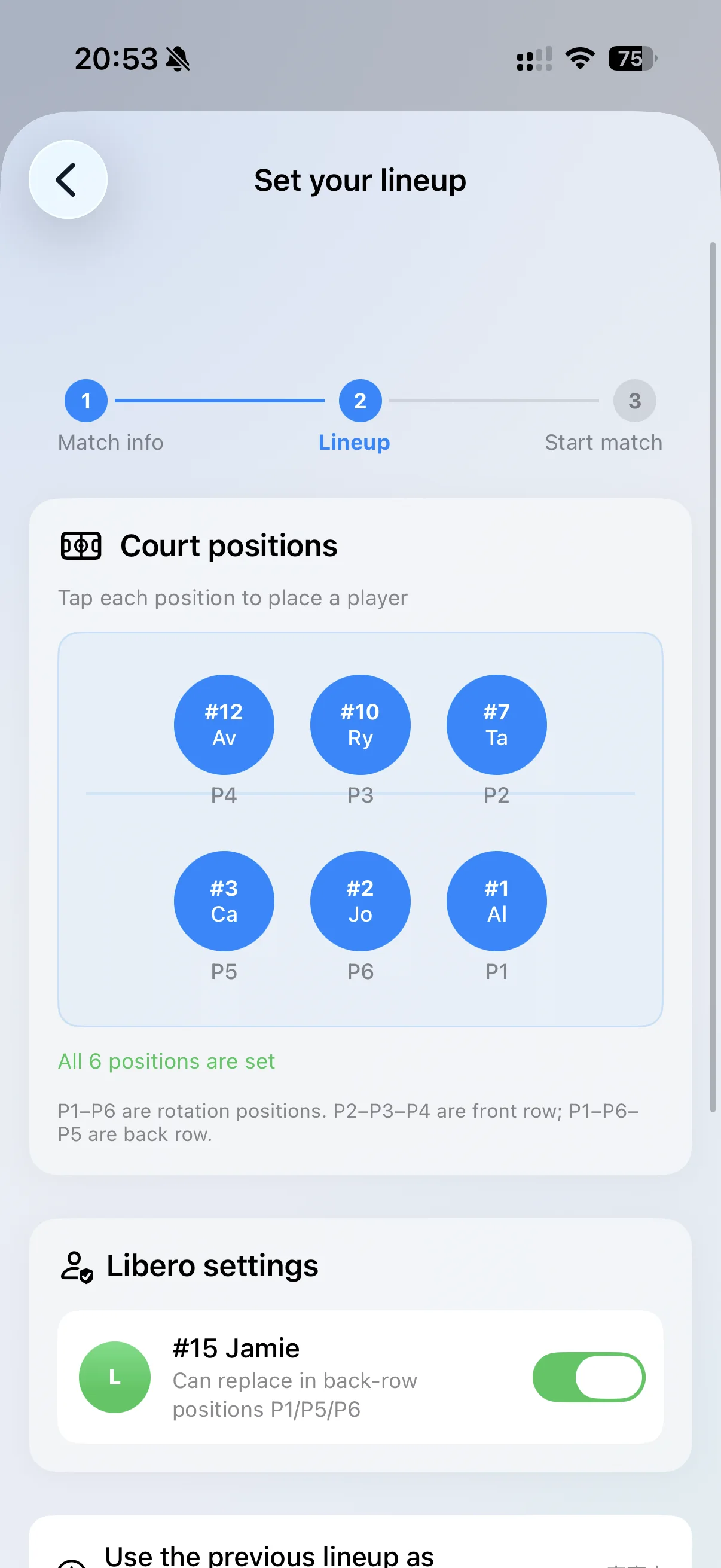
- A 5-1 uses one designated setter through all six rotations.
- A 6-2 uses two setter-hitters, with the back-row setter running the offense.
- Both systems still need a legal order, serve-receive plan and first-attack plan.
- The better system is the one your roster can execute and your staff can review consistently.
A 5-1 volleyball system uses one designated setter in every rotation. The setter runs the offense from both the front row and back row, giving hitters one consistent setting relationship while the available front-row attack changes across R1-R6. A 6-2 uses two setter-hitters and lets the back-row setter run the offense.
A coach should not choose between them from a diagram alone. Setter consistency, blocking, attacking depth, substitution limits, serve-receive responsibilities and training time all matter. The comparison below starts with a simple legal-order reference, then connects the system to the questions that appear during a match.
The short answer
Choose 5-1 for one-setting relationship. Choose 6-2 only when two setters and the roster make the extra complexity worthwhile.
Neither label guarantees better offense. The system must preserve a reliable first contact, a reachable setter and attack options the team can repeat.
- 5-1 One setter, changing front-row options.
- 6-2 Two setters, three front-row attackers.
- Both Need six-rotation planning and review.
Interactive legal-order reference
Compare the setter across R1-R6
Switch systems and rotations. The court shows rotational order before any serve-receive stack or transition movement.
Active setterOther front-row attacker
One setter across six rotations
The same setter runs the offense from the front row and back row.
- Active setter
- Setter in P1 · back row
- Front-row picture
- Three dedicated front-row attackers.
- Coach check
- Can the setter release from right back without taking first contact?
Important: this is a simplified rotational-order reference. It does not validate overlap, competition-specific substitutions, Libero replacements or a universal serve-receive formation.
What 5-1 and 6-2 mean
One setter, five attacking-role players
One designated setter runs the offense in every rotation. When that setter is back row, three dedicated attackers are front row. When the setter is front row, two dedicated attackers remain, with a possible setter attack when legal and appropriate.
Two setter-hitters, three front-row attackers
Two players are opposite in the rotational order. The one in the back row sets; the one in the front row fills an attacking role. This can keep three attackers at the net, but the team must coordinate two setting relationships and more lineup detail.
The first number is commonly used to describe attacking-role players and the second the number of setters used in the system. It does not mean eight players are on court in a 6-2. The two setters also carry attacking responsibilities when they reach the front row.
How the 5-1 changes across six rotations
The 5-1 gives the offense one setter voice, release pattern and setting relationship. The tradeoff appears when the setter rotates to the front row. The system should account for the change in front-row attack options rather than pretending every rotation is identical.
| Reference | Setter | Front-row picture | Question to plan |
|---|---|---|---|
| R1 | P1 · back row | Three attackers | Can the setter release without becoming a primary passer? |
| R2 | P6 · back row | Three attackers | Who owns the seams around the setter's middle-back release? |
| R3 | P5 · back row | Three attackers | Can the left-back release path stay clear of the passing lanes? |
| R4 | P4 · front row | Two dedicated attackers | Which first attack stays reliable with the setter front row? |
| R5 | P3 · front row | Two dedicated attackers | How will the setter release without blocking a hitter's approach? |
| R6 | P2 · front row | Two dedicated attackers | Can serve receive protect the setter and intended left-side option? |
R1 naming is not universal. This guide uses the common coaching reference of the setter starting in P1. Some programs label rotations from a different first server or lineup reference. Write down the convention your team will use.
How the 6-2 changes the decision
In a 6-2, the setter in the back row runs the offense while the opposite setter takes a front-row attacking role. After three rotations, those responsibilities switch. The benefit is a three-attacker front row; the cost is more role coordination, two setting relationships and potentially greater dependence on substitution strategy.
A 6-2 is not a shortcut for avoiding setter development. Both setters still need to locate from different back-row positions, communicate with hitters, handle transition and deliver hittable balls under pressure. The staff also needs a clear plan for blocking, back-row defense and what happens when a setter takes first contact.
5-1 vs 6-2: a coach decision table
| Decision | 5-1 | 6-2 | What to test |
|---|---|---|---|
| Setter continuity | One setter in all rotations | Two setters share the offense | Can both setter-hitter groups run the same tempo and calls? |
| Front-row options | Three with setter back, two dedicated attackers with setter front | Three attackers when the back-row setter runs the offense | Do the extra option and matchups improve real first-ball offense? |
| Blocking | Setter must block while front row | Front-row setter-hitter can fill a right-side role | Which lineup gives the team a repeatable right-side block? |
| Roster demand | One setter carries every rotation | Two capable setters who can also attack or transition into the planned role | Are two players genuinely ready for both responsibilities? |
| Substitution load | Usually simpler | May require more substitutions depending on roster design | Does the competition's substitution rule support the intended pattern? |
| Teaching load | One setter framework, six changing front-row contexts | Two setters, role switches and more handoffs | Can the team execute it under serve pressure, not only in a walk-through? |
What neither system solves automatically
- Serve-receive ownership. The system name does not decide how many passers, who owns each seam or how the setter releases.
- Legal overlap. A tactical stack still needs to preserve the positional relationships required by the rules in use.
- First-ball connection. A perfect drawing is not useful if the pass, setter route and attacker approach collide.
- Out-of-system play. Both systems need a clear high-ball and emergency-setting plan when first contact breaks down.
- Match evidence. A rotation result identifies a context. It does not prove that the offensive system caused the result.
Use the free serve-receive formation planner to add passer lanes, setter release, seam ownership and the intended first attack to all six rotations.
Map either system in six steps
- Choose one R1 convention. Identify the first server or setter reference the entire staff will use.
- Place opposite role pairs. Map the setter and opposite, outside hitters and middle blockers three rotational positions apart where that structure fits the system.
- Rotate every player clockwise. Complete all six legal-order references before drawing tactical movement.
- Add the Libero and substitution plan. Apply the rules and competition procedures that govern the match.
- Draw serve receive separately. Mark passer lanes, setter release, first attack and emergency responsibilities for each rotation.
- Test with a real serve and score. Walk-throughs confirm memory; game-like reps reveal whether the responsibilities hold under pressure.
Download the free A4 or US Letter six-rotation planner to keep R1-R6, system notes and one post-match review question on a single page.
From rotation diagram to match evidence
A lineup diagram answers where the players begin. A match record answers where pressure returns. Review service state, first contact, available attack and the scoring run before changing the entire system.
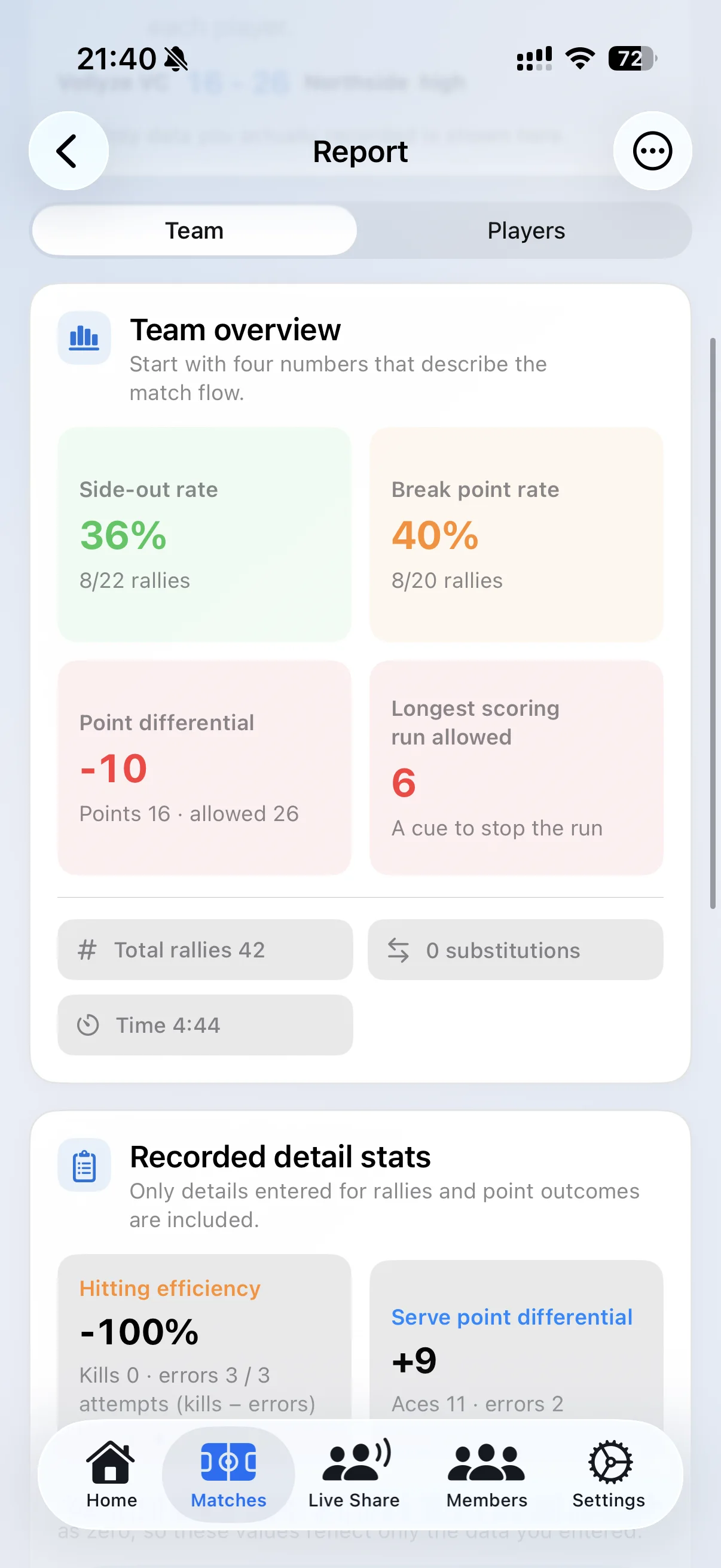
- Issue
- Side-out became unstable in one setter-back rotation when the serve targeted the deep seam.
- Evidence
- The longest run against began there, and the intended first attack was unavailable on three recorded rallies.
- Response
- Keep the system, clarify seam ownership and retest the same first-ball pattern before making a larger lineup change.
Which system fits youth, high school or club volleyball?
Age label alone should not decide the offense. A developing team may use a 4-2, 5-1, 6-2 or another progression depending on setter readiness, roster depth and coaching goals. A high school or club team with two capable setter-hitters may benefit from a 6-2. Another team may gain more from the continuity and accountability of one setter in a 5-1.
Choose the simplest structure that preserves meaningful development and can survive a difficult serve. Then review whether it creates the intended first attack, not whether it looks advanced on paper.
Competition rules matter. Lineup submission, positional relationships, Libero use, substitutions and electronic-device policies vary by governing body and event. Confirm the current rule book and tournament instructions before match day.
Primary references: FIVB Official Volleyball Rules 2025-2028, the FIVB rotation overview, USA Volleyball's setter-system coaching resource and the current NFHS volleyball rules resources. Apply the code used by your competition.
Frequently asked questions
What is a 5-1 volleyball rotation?
One designated setter runs the offense through all six rotations, from both the front row and back row.
What is a 6-2 volleyball rotation?
Two setter-hitters are opposite in the order. The back-row setter runs the offense while the other fills a front-row attacking role.
What is the main difference?
The 5-1 prioritizes one setting relationship. The 6-2 can preserve three front-row attackers but adds a second setter relationship and more lineup complexity.
Which is better for high school volleyball?
Neither is universally better. Test setter quality, blocking, attack options, substitution limits, roster depth and how consistently the team can execute each system.
How do players rotate?
When the receiving team wins the right to serve, all six players move one position clockwise in the rotational order.
Do the diagrams show a universal serve-receive stack?
No. They show a simplified rotational-order reference. Teams must plan legal relationships, passer lanes, setter release and first attack separately.
How should a coach evaluate the system?
Keep the lineup with the score, then review side-out, break-point, first contact and scoring-run context before deciding what to train or change.
Keep the rotation connected to what happened next.
Start free in Vollyze, set the lineup, record one match and turn a repeated rotation problem into one practice decision.